Guess Who’s Coming to Dinner: Part 1 (Alice Cooper)
GUESS WHO’S COMING TO DINNER:
MY DREAM INVITE LIST (Part 1)
Today, I’m starting a totally new writing series. This should be fun!
Read further and join this imaginary experience. Ride along. Better yet, ponder this question and then create your own list. Make your posts here on Facebook, and do your own series: Name the ten people you would invite to a lavish dinner for a night of great conversation. Just as important if not more so, explain *why* they made your list.
I’ll begin with my first invited guest at my grand once-in-a-lifetime dinner:
Most rock musicians, especially the icons, are actually dull conversationalists. They’re horrible in interviews. Boring. Repetitive. One-dimensional. Self-absorbed. This opinion might sound ridiculous, but it’s true. Take almost any classic rocker (and most musicians) and they’re magical performers onstage and while playing music. But, most of the greats are not good storytellers, nor particularly insightful in a conversation.
Alice Cooper might be the very best *exception* to what I just wrote. He is exceptional, in every way,
Strangely, I’m not a huge Alice Cooper fan. I respect his music and remember his hits during the 1970s. I even saw his performance (on video) at last weekend’s NFL Las Vegas Raiders home game. He did the halftime show — at age 78.
No, what sets Vincent Damon Furnier (a.k.a. Alice Cooper) apart isn’t so much being the universally-acclaimed godfather of “shock rock.” It’s his ability to communicate. It’s his sincerity. It’s his being real. It’s being humble. It’s being self-aware. It’s his undeniable oddity and appeal, and making those around him feel welcome and connected. And then of course, the thing that truly makes a great dinner guest…. the unexpected.
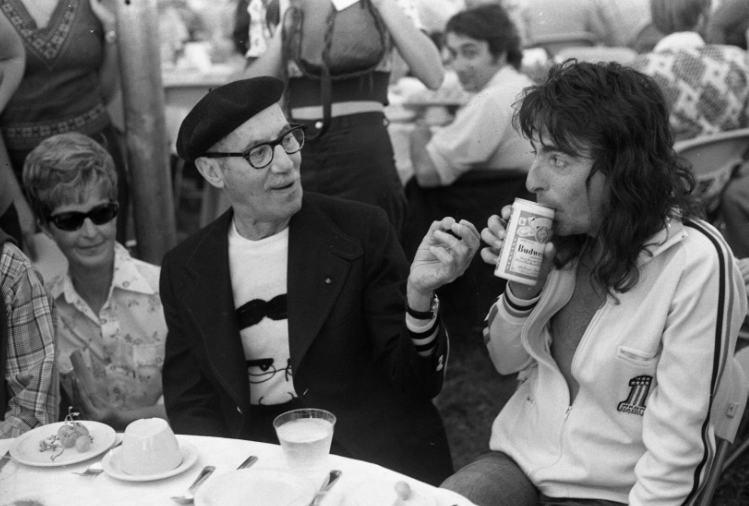
Let me put it another way: If this guy was longtime best pals with Groucho Marx, that says it all. If he’s good enough to drink beer every night with Groucho, he must be a helluva’ presence.
Some facts I learned, and you may not know about — Alice Cooper:
– born in Detroit
– raised in Arizona
– his grandfather was an evangelist protestant missionary
– his father was also a pastor
– both his grandfather and father ministered to Native American Indians on local reservations
– grew up in a loving household, his parents even encouraged his musical career and played rock music inside their home (unusual for the 1960s)
– dated the sexiest woman alive back then, Raquel Welch
– after a wild bachelorhood, then married to the same woman for 50 years–and counting (married in 1976)
– father of three children
– never uses the name “Alice” with family and friends (“it’s a persona”)….those closest call him Vinnie
– was part of the famed rock rat pack of the 1970s in Los Angeles, made up of John Lennon, Harry Nilsson, Mickey Dolenz (Monkees) who did the club scene every night
– known for heavy metal and glam rock, but his origins as a stage performer were rooted in an early love of Vaudeville and over-the-top theatrics
– signed to his first record deal by Frank Zappa
– met Elvis in 1971 and was invited to his Las Vegas Hilton (International, back then) suite, where “the King” produced a snub-nosed revolver (great story)
– 30 albums, to date and 50 million records sold.
– plans to continue performing and touring, into his 80s
– opts to be non-political though he’s made many controversial statements, both supportive of left and right causes
– plays full round of golf 4 to 5 times a week (and is very good at it)
– his daily longtime golfing partner was the late country legend and stellar session guitar player and later TV star Glen Campbell (they were neighbors)
– was also neighbors with comedy legend Groucho Marx in an unlikeliest friendship. They often drank beer together at night and watched ballgames in his living room
– huge fan of Detroit sports teams, and Arizona Diamondbacks (baseball)- owns the first “O” on the famous Hollywood sign (he was the first to buy a letter, then got other celebrities to each buy one to preserve the iconic sign)
– did voice overs for lots of cartoons and video games (some you probably didn’t know it was Alice Cooper)
– Regularly had old Hollywood icons at his shows on the front row and backstage, including Marx, Bette Davis (who inspired his stage makeup)
– wrote the theme for the James Bond movie, “The Man with the Golden Gun” but it was decided he was too controversial so the song was scrapped at the last minute
– plays a mean ass harmonica and most of his shows have at least a few songs where he blows the roof off. See a link HERE as just one of hundreds of performances.
When I think of great interviews, conversationalists, and dinner guests it all starts with stories. And Alice Cooper delivers, while being humble and totally himself.
He’s an easy choice as one of my (imaginary) ten invited dinner guests.
More coming tomorrow.
(In the meantime, watch this short interview with Alice Cooper by Dan Rather — CLICK HERE — to get a feel of why he made my list)
Read More