



Turning Point: The Vietnam War (Five-Part Netflix Series Review)
TURNING POINT: THE VIETNAM WAR (NETFLIX SERIES–REVIEW)
“You will kill 10 of us, we will kill one of you. But in the end you will tire first.” — Ho Chi Minh
“We’re killing these people at a ratio of 10 to 1.” — Army Gen. William Westmoreland, U.S. supreme commander in Vietnam
“Westy, the American people don’t care about the 10, they care about the one.” — Sen. Fritz Hollings, a decorated World War II veteran from Westmoreland’s home state of South Carolina
The Vietnam War ended 50 years ago. The recent anniversary date (April 30, 1975) prompted several retrospectives–old and new. As is the case with many historical events, the passage of time does provides a broader, deeper, and clearer perspective of what really happened. Much like a forest and the trees, some distance away from the subject often provides the best vantage point.
Even so, we still may examine the same events, and then reach very different conclusions. History isn’t just about remembering a quiescent past. Rather, it’s a reactive interpretation between then and now. Examining things that made us who were are — individually and collectively — may even provide a wiser direction for the future. History speaks to us, sometimes loudly and clearly, if we take the time to listen and learn.
The Vietnam War, initially released in 2017 and debuted on PBS remains in my opinion one of the best historical documentaries ever made. That 10-part, 18-hour series from directors Ken Burns and Lynn Novick presented firsthand accounts of the Vietnam War. The stars were the many witnesses who were interviewed, including Americans who fought and many who opposed it, as well as North and South Vietnamese combatants and civilians from both sides of the civil war that lasted two decades and cost millions of lives.
Now in 2025, when Netflix listed a new streaming 5-part, 6-hour series titled Turning Point: The Vietnam War, the idea seemed repetitious. Skeptical, I wondered what added perspectives and new lessons might we can learn.
Turns out — quite a lot. Here are my thoughts with a few comments on each episode, focusing on the revelations:
PART 1: “America Goes to War” — Most Vietnam documentaries which too often concentrate primarily on the American vantage point promote the false narrative and a historical myth that President Kennedy was largely blameless for the war’s escalation 1961-1963. Yet, all evidence (shown here) points to the contrary. A ridiculous revisionist perspective has even emerged claiming JFK tried to stop America’s involvement in the war, which has no basis in fact. The documentary boldly exposes this preposterous distortion and shows JFK’s repeated mismanagement at various junctions of crisis leading to escalation, including the first American casualities. His recurrent deference to hawkish advisors (McNamara, Rusk, etc.) led to spiraling political and military burdens that would sink the United States into a giant Vietnamese quicksand. In fairness to Kennedy’s (and later Johnson’s) legacies, any President in office during that time likely would have followed a similar course of action. Nonetheless, this documentary was the first I’ve seen that challenges the many falsehoods surrounding JFK’s actions and intentions.
PART 2: “Civil War” — Americans often ignore (or simply don’t know) Vietnam was engaged in a two-decades long civil war between north and south. Most Vietnamese people were not communists, but South Vietnam’s internal corruption and ghastly ineptitude gradually eroded popular support for leadership in the south and incrementally shifted allegiances within provinces. Eventually, South Vietnam’s position became untenable — and far worse, American leadership knew it was a lost cause. The leaders most associated with the war’s immensity and destruction include names very familiar to us–including Johnson, Nixon, McNamara, Westmoreland, Thieu, and certainly Ho Chi Minh. However, Le Duan who was the original founder of the Indochina Communist Party and the undisputed leader of North Vietnam after Ho’s death in 1969 through 1975 (later, he ruled the newly unified Republic of Vietnam post-war from 1976 until his death in 1986) was the war’s primary architect and singular most influential figure. Chairman Ho received most of the accolades (the network of trails of supply lines in his name, and later the renaming of Saigon in his honor). Yet, it was Le who promoted the hyper-aggressive military tactics that defeated a superpower. Had Le not been so influential, it’s very possible there might still be two Vietnams today, or the conflict may have even continued indefinitely. For all his brutality, Le Duan should go down in history as one of the most remarkable military and political tacticians of the 20th Century. Fittingly, he receives his due in this documentary.
PART 3: “Life is Cheap” — This episode was difficult to watch. This was the first war where the lines between military and civilians were not just blurred, but indistinguishable. With all the talk of terrorism in the world today, the shooting, bombing, torturing, and mass execution of civilians was quite common in Vietnam, taking place repeatedly among both sides of the conflict. North Vietnam’s use of terror was deliberately cruel, so as to instill fear in the population. But perhaps the most destructive and counterproductive policy of the war was the use of “body counts” as a metric of success and progress. Over multiple years, as many as *10* (alleged) communists were killed for every *1* American. The 10-1 body count made the situation seem that the war had “light at the end of the tunnel” and could be won with more troops fighting, and killing. Trouble was, since dead bodies were the trophies of war, both American and South Vietnamese forces prioritized death from any sources — men, women, old, young. The bigger the pile of dead on battlefields and in villages, the better. “Kills,” more specifically the kill ratio, was the war’s scoreboard. NVA’s own terror tactics combined with the “body count” metrics on the war’s progress on the part of ARVN and American forces grotesquely contributed to distortions, becoming a mass factory of death where “life was cheap.”
PART 4: “Why Are We Even Here?” — Part 4 was the weakest segment of the series, mostly repeating what’s already been portrayed many times about the growing anti-war movement, which for all its numbers didn’t actually hasten the war’s end. Popular support for the war shifted in 1968 after the Tet Offensive, but it was five painful years (and 20,000 more American lives) later that U.S. forces finally evacuated the civil war, leaving north and south to continue fighting it out; and then another 7 years until the war finally ended. At the time, defending South Vietnam wasn’t looked upon for any moral or humanitarian reasons. It was simply a snake-shaped square on the much broader chessboard, a proxy nation and battle test for the much larger global conflict between West and East (aligned around ideologies which were at odds). Note: Given the release of more historical documents, including tapes from the White House, we’ve learned in recent years that Richard Nixon (certainly his campaign) may have worked to sabotage a 1968 peace deal that was in negotiation by LBJ. This is a critical revelation, deserving of more scrutiny and investigation–but at least it’s mentioned in passing here, whereas previous Vietnam War documentaries do not include this updated information.
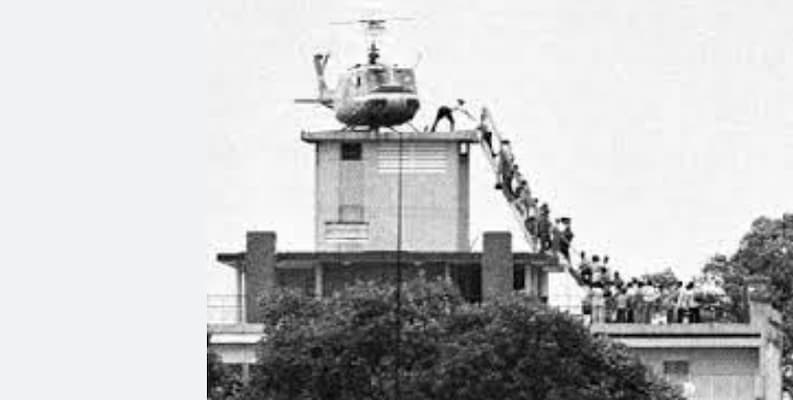
PART 5: “The End of the Road” — The end of the Vietnam War is the story of heroism and heartbreak. American military forces which had numbered 500,000 by 1969, were mostly gone by 1974 and within 18 months, South Vietnam’s fragile government and defenses forces collapsed. The evacuation was criminally mismanaged by the Nixon (and later Ford) Administrations which should have begun the exit sooner, resulting in mass chaos. Hundreds of thousands of pro-American Vietnamese workers and allies were left behind, and many were simply abandoned (later to be imprisoned or killed). Yet to the documentary’s credit, we also learn of the heroic role played by American military forces who were there in that spring of 1975, who risked their lives for others (about 150,000 Vietnamese were airlifted out of the country, mostly onto Navy ships via helicopters….Side Note: My neighbors across the street, an elderly Vietnamese couple, were among those who got out thanks to brave American forces). We also see a very unusual perspective that I wish was given more time. Pro-North Vietnamese victors were interviewed and some say freely on camera that their own revenge and retribution towards the South (and its people) afterward was a terrible mistake. After the war ended, the killing should have stopped. It didn’t. In fact, neighboring Cambodia was about to suffer it’s own mass genocide ala “The Killing Fields,” which began immediately thereafter.
The Netflix documentary directed by Brian Knappenberger won’t surpass nor replace the stellar Burns-Novick film portrait of the war and the memorable people who fought it. But to be fair and honest, nothing will. What “Turning Point: The Vietnam War” does manage to accomplish is update the facts and remind us of a deadly conflict made far worse by national hubris, ignorance, and arrogance. If “truth is the first casualty of war” according to Aeschylus, the final casualties and costs are never known.
The Vietnam War may have ended, at least officially on paper, a half-century ago when communist North Vietnamese forces finally captured the capital city of Saigon which was the last bastion of American-backed South Vietnam. However, for many Americans then and now, and even more Vietnamese who suffered immeasurably worse loss and anguish, it didn’t feel like the war was over. Some battles are carried with us and never end, nor is anyone victorious.
— ND







Great review and much appreciated for taking the time.
Will make sure to watch it ….
Greatly enjoyed watching the series.
Hope you are doing well Nolan….
Look forward to reading more from you.
Regards
Thinking of your you and yours…
Keeping good thoughts.
Hope you reach out.
Daniel