The Godfather Turns 50
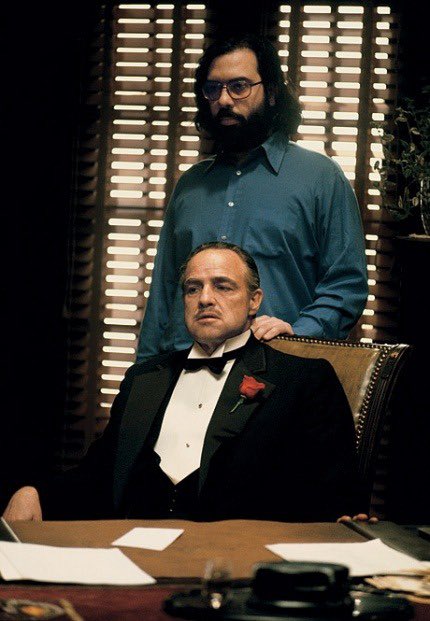
Fifty years ago on this date, The Godfather premiered on March 14, 1972.
Many of us revere Francis Ford Coppola’s masterpiece as the most perfect film ever made. I didn’t say the “greatest” film ever made, I said “perfect.” That’s because it’s difficult to imagine how this film could have been better than it is. The backstories of how The Godfather (based on Mario Puzo’s novel) came to be….why Coppola was selected to direct….controversies swirling around the casting….the stylistic filming and technical innovations….the shocking aftermath at the Oscars….and the careers of so many extraordinary actors associated with what would become a trilogy that were launched by this movie…..are all worthy of equal exaltation in Hollywood lore.
During filming in the spring of 1971, Coppola (who was just 32 at the time) was under intense pressure from Paramount Pictures, which strictly controlled the $2 million production budget. He weathered fierce resistance from the studio, which was in serious financial trouble, on nearly every major creative decision, including the casting of the eccentric and troublesome Marlon Brando (as well as Al Pacino, James Caan, Diane Keaton, Robert Duvall — all were initially rejected by studio execs). Paramount even began interfering with Coppola’s filming schedule, micromanaging the shooting, demanding the movie be wrapped on time and stay under budget. Coppola twice survived being fired in the middle of production.
“The Godfather was a very unappreciated movie when we were making it. They were very unhappy with it. They didn’t like the cast. They didn’t like the way I was shooting it. I was always on the verge of getting fired. So, it was an extremely nightmarish experience,” Coppola later recalled. “I had two little kids, and the third one was born during that. We lived in a little apartment, and I was basically frightened that they didn’t like it. They had as much as said that — so when it was all over I wasn’t at all confident that it was going to be successful, and that I’d ever get another job.”
Indeed, Coppola’s involvement in The Godfather happened as an accident of fate.
Robert Evans, head of Paramount at the time, specifically wanted an Italian-American to direct the film because research had shown previous films about the Mafia directed by non-Italians had fared dismally at the box office. Evans wanted to, in his own words, “smell the spaghetti.” When Coppola hit upon the idea of making The Godfather a metaphor for the moral compunction of American capitalism, his credibility enhanced by his Italian (actually Sicilian) heritage, he was offered the job to direct. “They wanted to make it at a very inexpensive budget, which was why I was hired.”
There’s another reason why Coppola took the job, which is little known. He was deeply in debt to another movie studio (Warner Bros.) for $400,000 following budget overruns on George Lucas’s 1971 film THX 1138, which Coppola had produced. The film lost money, leaving Coppola financially destitute. So, partially to work off the debt, he took “The Godfather” on Lucas’s advice.
Surviving cast members all have great stories to tell, though no one at the time knew The Godfather would become one of the most celebrated films in movie history. No one anticipated the massive success of the film. Recently in an interview, Al Pacino was asked at what point he knew this movie was going to be as great as it is. His response is quite a revelation about how important the essential quality of passion is in any successful endeavor:
“You remember the funeral scene for Marlon? It was over for the evening and the sun was going down. I was going back to my camper and there sitting on a tombstone is Francis Ford Coppola, weeping like a baby. Profusely crying. And I went up to him and I said, ‘Francis, what’s wrong? What happened?’ He says, ‘they won’t give me another shot,’ meaning they would allow him to do another setup. And I thought, ‘okay, I think I’m in a good film here because he had this depth of passion and here it is.”
Here’s the funeral scene that was done in just one take (hard to imagine this could have been better, but Coppola wanted to reshoot it):