



Why Spies Do What They Do (Movie Review: A Most Wanted Man)

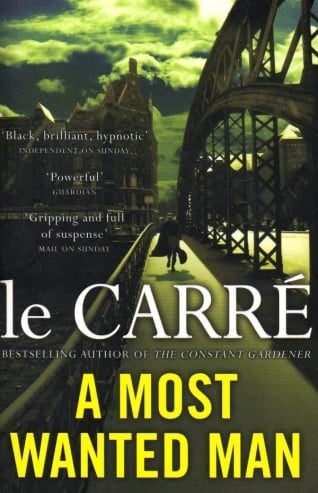
Philip Seymour Hoffman in one of his final on-screen appearances, A Most Wanted Man, based on the book by John le Carre
In the real world of clandestine intelligence-gathering operations, otherwise known as “spying,” no bullet ever gets fired. The good guys don’t swing on trapeze wires between skyscrapers over breathtaking city skylines. The villains aren’t giggly chrome-domed psychopaths holding hissing white Persian cats. The real spy game is subtle, and at times — messy.
Movie Review: A Most Wanted Man
British author John le Carre is a master of both realism and subtlety. His works were the inspiration behind spy-thrillers Tinker Tailor Soldier Spy, The Constant Gardener, The Tailor of Panama, The Russia House, and arguably his most acclaimed book (and film), The Spy Who Came in From the Cold.
After nearly half a century of writing about confidence-building and betrayal, secret meetings and surveillance, and the powers above it all pulling the puppet strings, le Carre has more than mastered his craft. A lifetime of immersion into the themes of spy novels continues to bear stories which remain both intriguing purely as entertainment, and far more important in shaping the way we read news headlines, metaphorically applicable to modern-day events and current global tensions.
A Most Wanted Man is perhaps the best film ever made of a le Carre novel. That’s saying a lot. Boosted by a stellar cast and understated drama which builds slowly with each turn of the page and film frame, A Most Wanted Man provides an A-to-Z account of the start and end of a typical intelligence operation, albeit with far-reaching consequences.
Set in gritty and grey modern-day Hamburg, we are reminded that this was one of the nests which incubated the 9/11 attacks. Since some of the terrorists previously lived in Germany before settling inside the United States, the Islamic community there has — with proper justification — become a target of interest to the intelligence community. Being that 9/11 represented the ultimate intelligence failure (on a preposterous number of levels, I might add), the West continues to try and play “catch up,” desperately trying to infiltrate terrorist cells in order to learn about what might be the next act of terrorism, hopefully before it ever happens. However, given the way global politics works and the utter incompetence of some high-ranking officials, the next bombing isn’t just a matter of if, but when.
No surprise, this film is carried almost entirely by Philip Seymour Hoffman in one of his final film roles just prior to his death. I can’t even imagine any other actor in the role. A posthumous “Best Actor” Oscar nomination should be a given. Filmed in late 2013, we are reminded once again of the late actor’s extraordinary range, playing a lonely boozing and chain-smoking freelancing spy who’s essentially “for hire.” Given that domestic laws prevent some forms of intelligence gathering, much of the dirty work has been outsourced to people like Hoffman. One can only imagine scenarios that play out in many countries where this type of thing actually does exist (not in America, of course — wink, wink).
Hoffman’s character is good at what he does — very good, indeed. This is why he gets hired in some of the world’s most troublesome hot spots. But he’s also been betrayed before, and now trusts no one. Yet, he must trust someone, for that is how the spy game is played. Motivated by a higher calling perhaps, simply the freedom of being himself, and perhaps by the naked fact that he has no other skill set and nowhere left to go, Hoffman is stuck on a dead-end career tack to nowhere which begets no vacation time, no company parties and picnics, and little self-satisfaction. Hoffman’s family is his job. In fact, we’re left to wonder why Hoffman does this messy work at all — being so frustrating and unfulfilling as it truly is.
Other actors are perfectly cast, too — including Robin Wright as the American intelligence attache who actually calls the shots of the world’s only truly global superpower in the game, Willem Dafoe as a corrupt banker who gets compromised, and an ensemble of mostly unknown German and Turkish/Arabic supporting actors who move the plot along towards an edge-of-your-seat final 15 minutes.
Make no mistake. This is not a movie with car chases and explosions. If you want cheap fictional thills, then look elsewhere. This is the real way intelligence-gathering gets done, which tests the mental and ethical boundaries of anyone who’s been involved in such work.
Without giving away too much of the plot or the conclusion, the film excels as a perfect metaphor for the way the real world works, and how each player and nation behaves in the dangerous game. Hoffman’s approach is soft and subtle. He’s convinced that good intelligence takes time. It can’t be rushed or forced. But those for whom he works and answers to want results now. He’s given 72 hours to wrap up the case, or the muscle will be called in. The clock is ticking.
As the film plays out, we don’t necessarily view the terrorists as adversaries. Sure, they’re evil and must be stopped. That’s a given. But the real obstacles are the ceaseless bureaucracy, posturing politicians, needless intelligence briefings with paper pushers, and those who should otherwise be considered to be allies in the righteous fight against global terrorism. Hoffman may think he’s in charge. But he’s nothing more than an ineffectual pawn in much bigger chess game to be willingly sacrificed for bishops and rooks in order to ultimately capture the evasive king on the global chessboard.
The end of A Most Wanted Man will not be satisfying to all. It leaves us wanting to know more. But one imagines there are many more actual real-world scenarios like this one, rather than contrived payoffs designed to instantly gratify the movie audience masses. Sorry, but evil is never eradicated, nor does James get the latest Bond girl supermodel.
If you ever wondered what the spy game is really like, then take a few hours and immerse yourself in this movie. Watch the soft interplay between the desperately lonely Hoffman and the steely efficiency of Wright as they ponder their options. Marvel the revelation of advanced interrogation techniques and weapons of psychology which are dead-on accurate — about as close to the real thing as has ever been shown on film. For the rest of you, there’s always Barbara Broccoli’s stale corporate-infused Bond franchise. As for me, I’ll take a solid film based on a great John le Carre book and the sad swansong of one of contemporary Hollywood’s greatest film actors over fantasy, any day.
The larger question was — why do spies do what they do? That’s the real mystery we are all left to ponder.





0 Comments
Trackbacks/Pingbacks