My Battles in the War on Disco

I watched an interesting documentary last night. It was on the weekly PBS series, American Experience, one of the most insightful self-portraits of our history and culture on television which has now run over the past 40 years. The title of the latest episode is “The War on Disco.” Accordingly, I have some observations on this subject and the program that I’d like to share.
Putting aside the enormous and far-reaching cultural implications of the “disco era,” some of what I share here will be part-confession, part-revelation, part-evolution, and part-counterargument. Perhaps there’s even some template here that could foster a broader understanding of other subjects. Hopefully, I’m open to that–and so are you. It is interesting how our reactions and attitudes to things does often change. I think a big part of change and evolution simply requires being confronted with facts and alternative points of view. And even though we might not fully change our attitudes, at least there’s something gained when we better understand how and why someone else thinks and believes differently than the way we do.
Music is one of those things that ignites lots of passion. Far more passion than sports or politics, even. Attack someone’s music or their favorite artists, and it’s personal. For instance, I’ve written more than 2,000 articles posted on my website and to this day, ten years after it was published, one particular article critical of “modern music” remains in the all-time top-5, with nearly half a million hits and nearly a thousand comments, to date (including a few death threats–yes, I’m serious). People get pissed as hell if you attack their music.
My reaction to disco depends upon the year. Let’s just say I’ve gone through stages. I lived through the age during the mid- to late-1970s when disco was at the height of its popularity. Disco influenced everything, not just music. I always felt robbed that my generation’s musical icons weren’t sitting behind massive drum kits and strapped to electric guitars. They were preening on platform shoes, colored in fruity leisure suites, and spinning under mirrored disco balls. The generation right before me had the Beatles. We had the Village People.
Yes, disco sucked–I thought. Like most everyone, I was purely a petty product of my personal background, my race, my middle-glass upbringing, my city, my neighborhood, my friends — all intertwined as into one as my tribe. Rock n’ roll was and would *always* be king, and no freak who looked and sang like Sister Sledge or Boney M. or Donna Summer was going invade my space and cut off my testicles. Indeed, it seemed like disco was an attack on masculinity and manhood. It was androgynous. Dancers. Gays. Hell, they didn’t even play instruments! Fuck that!
I’m not proud of thinking that way, but that’s just the way it was back then.
Since then, disco faded. It now seems as dated as Doo wop. Walk down the street today in discoteque clothes and everyone will think you’re headed off to a Halloween party. It’s become a punch line, which is kinda’ sad really, because everything about disco was such a genuine expression of individuality and a bold artistic statement, from the pulsating beat to the brilliant colors to the wild hair to the cardboard lapels. Perhaps a better way of describing inevitable changes in public taste is to say that disco evolved, that is, it morphed into other forms of music.
Then, something really weird happened. In the years since my early “disco sucks” phase, I began enjoying disco. I’d hear it played someplace and say, “hey, turn it up!” A disco hit popped up in a movie soundtrack and a few hours later I was on Youtube, listening to the full version. One boogie night at a time, the spell was cast.
My growing appreciation of disco was also fueled by my greater understanding of it. In fact, disco was that completely natural progressive next step in the long and endless evolution of songs, and sounds, and popular entertainment. For bettor and for worse, it completely reflected the excessive times when it ruled our collective consciousness and amplified every fantasy. Perhaps most important, disco was a window to look in and finally the door to break through for millions who had previously been excluded and and disenfranchised from pop culture. The real counterculture wasn’t rock. It was disco and divas singing about survival. Disco was closely associated with black expression and gay pride, though disparate, linked inexorably by converging paths and common struggles throughout their histories. For many, disco was the glorious sound of liberation.
A few years ago, an excellent documentary about the Bee Gees ran on HBO. I was mesmerized by several indisputable points made about the mass movement of hate against the Bee Gees back during the ’70s and I must plead guilty on all counts as a fist-pumping outraged co-conspirator among millions of other teenage white males. Today, I love the Bee Gees and think their music stands up extraordinarily well over time, certainly on par with any classic rock band. To this day, their musical genius remains under appreciated.
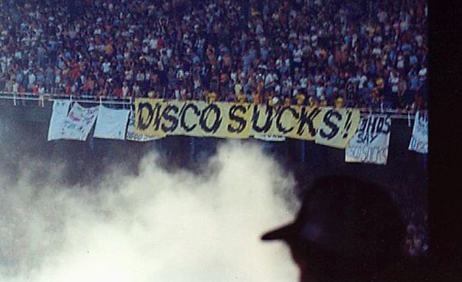
Last night’s PBS documentary put yet another spin onto disco’s record. It focused mostly on the notorious 1979 event called “Disco Demolition Night, which took place during a Chicago White Sox baseball game. Admittedly, while watching it, I found myself laughing and ashamed all at the same time. Demolition Disco Night is considered by many as the beginning of the end. It was *the* turning point for disco. For those unaware, back in the summer of ’79 on the south side of Chicago at old Comiskey Park, two of the worst teams in Major League Baseball were playing a doubleheader. A week before game time, someone in the White Sox organization decided to allow anyone who wanted to attend the game to come in for 98 cents, on the condition that they must bring in a disco record or album. In between games, the records and albums would be passed down into the field, gathered in a giant box, and blown up in an explosion that turned into a bonfire. Organizers expected attendance which had been embarrassingly low all season long to attract perhaps another additional 5,000 fans.
Well, 50,000 showed up, and another 20,000 “fans” gathered outside demanding to get in. Everyone was towing disco records, presumably anxious to see them blown up during a meaningless game between two losing baseball teams (how these disco “haters” somehow possessed so many thousands of disco records remains an unsolved mystery).
In between games, a popular Chicago rock DJ (who had lost his job earlier because the local radio station switched to a disco format) might as well have been the radical musical revolutionary equivalent of Che Guevara, came into the field armed with a microphone. All the disco records has been piled up like the Eiffel Tower at second base and whoever was in charge of the explosion must have been some kind of sick arsonist who *really* hated disco. The explosion became a giant bonfire, and like moths drawn to a flame, thousands of beer-drunk “fans” overwhelmed security and spilled onto the field. Within seconds, the angry mob had taken over Comiskey Park. The disco-hating mob gathered outside reportedly got inside when the overwhelmed White Sox ticket tellers simply walked away from the gates. Game 2 of the scheduled doubleheader was cancelled, then forfeited. The asylum had been turned over to the insane.
All because of hate for disco.

I was a senior in high school at the time. News of “Disco Demolition Night” in Chicago made headlines, even in Dallas where I grew up. We all thought it was the greatest thing ever. Rock on! There’s a lesson here in lots of things. Perhaps we’re all subject to mob influence and the excessive dangers of a lynch mentality. Populist outrage is very real. It may change allegiances, but the triggers are always pulled back and the gun of passion is perpetually ready to fire and that goes for politics and religion as much as music, perhaps even more so.
The current political climate and cultural divide that has become all too consuming is largely rooted in many of the reactionary excesses we saw that hot summer night 44 years ago. Think about it. Angry White working-class (mostly decent and law-abiding) people felt they’d been replaced, and subjugated, and worse of all ridiculed. And they didn’t like that the traditional ways of doing things was changing into a society and culture of more inclusion and greater diversity. Some of those reactions were/are based on ignorance and fear. But some were/are rooted in personal experiences. The American Experience documentary noted that disco didn’t live up to (nor practice) its own ideals of openness and inclusion. If you didn’t look, or dress, or act a certain way, you were not let inside. Not into the clubs. Not into the culture. If a White working-class guy showed up at Studio 54, he’d be treated like a Black man in the Jim Crow South. Anyone could attend a rock concert and pretty much feel welcome. But disco, and certainly that whole scene also had an ugly side that made many people feel excluded. Call it the red velvet rope treatment. You didn’t belong unless you fit a certain profile. Discrimination had been turned upside down and flip-flopped.
I suspect that many of the same things that once rightfully applied to disco (back then) might now apply to rap music (or hop hop) today. I wouldn’t purport to write anything or have much of an opinion on this because I lack any any subject knowledge thereof other than obvious biases against it. But at least I’ll admit to my own prejudicial biases which may be unshakable. I’m still navigating. To its credit, at least rap and hop hop music and culture does seem far more inclusionary, far greater so than the disco phase. It is truly multi-cultural, gender neutral, and international. It’s the anti-globalist’s worst nightmare. Conspiracy theory fodder: Jay-Z is actually George Soros.
Different phases of our lives encompass different sets of truth. We think about things very differently when we’re 20 vs. 60. Hopefully, as we do get exposed to more information and think about things bit more and have some of those old assertions challenged by new facts and alternative points of view then we ourselves are subject to changes within.
I wish disco was a good metaphor for lots of other topics in life that are important where we’re confronted with new ideas. May we all ultimately evolve into a better place while we’re stayin’ alive.