



Movie Review: “The Butler” Serves Up Historical Farce on a Silver Platter
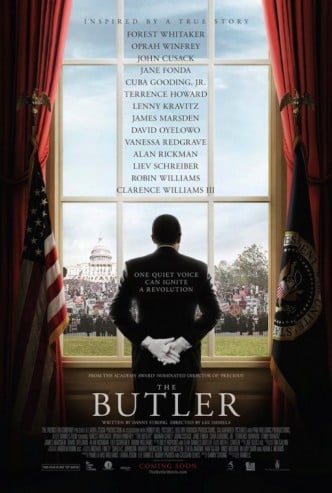
The Butler opens with an important disclosure: “Inspired by a True Story”
Which begs a few questions — what’s true and what’s not?
We know this much. There really was a butler named Eugene Allen who once worked in the White House. He served (quite literally) eight U.S. presidents. What’s most alluring about Allen’s unflappable term of service is that such a devoted mission took place during the nation’s most tumultuous period of race relations. The 1986 America when Allen voluntarily retired from the White House personal staff was markedly different from the 1952 America when he was initially hired to polish the silverware, shine shoes, and serve coffee. Or, was it?
The Butler presents two parallel storylines, neatly contrived, and exaggerated to frequent points of absurdity. Eugene Allen’s role as White House butler gets a major makeover on the very first page of the screenplay as the central character’s real name is scrubbed out to become “Cecil Gaines.” Oscar-winner Forest Whitaker gives his usual applause-worthy performance in the title role as a man with calm dignity determined to support his family in the only way he knows, by playing loyal house servant to the most powerful white men in the world. For this position, staying in power requires silence, even in the midst of some of history’s most monumental discussions and decisions while in his presence. [SEE FOOTNOTE]
Another standout performance comes from the butler’s oldest son, played perfectly by David Owelowo, a Nigerian-born English actor with a distinguished resume of interesting film roles (including a previous supporting role alongside Forest Whitaker, who played Idi Amin in The Last King of Scotland). It’s nice to see these two outstanding actors reunited again. This time their deep divisions — sparked by an intense generational clash in attitudes about the best way (resistance versus non-violence) to achieve racial equality — are what carries the film.
Beyond the predictable family feud and ultimate revelation and reunion, other lead characters are tedious and instantly forgettable, save for the appalling portrayals of the presidents, which I’ll get to in a moment in some detail. Oprah Winfrey is cast as the butler’s often-neglected wife. Perhaps she’s the helpless victim of her own “brand” popularity, but I couldn’t quite shake the realization that I was always watching “Oprah” up on the big screen, rather than the character she was presumably portraying. The butler’s many co-workers and sidekicks should have made for added depth and a wonderful opportunity for reflection. Instead, multi-talented Terrence Howard, Cuba Gooding, Lenny Kravitz, and others come across as wasted stage props. One presumes everyone who is Black in Hollywood wanted a role in this movie, and so a stadium full of extra roles were needlessly scripted, which drags down the film.
Then, there are the presidents — an embarrassing eight-ring circus of clownish performances which might have been laugh-out-loud funny were they not so appalling awful, and historically offensive.
Let’s start with Robin Williams playing Dwight D. Eisenhower. After that folly sinks in for a moment and you catch your breath again, imagine Williams in a poorly-contrived Saturday Night Live skit, and that’s pretty much the picture. One would think Williams — who has demonstrated great thespian range in several serious past roles — could have at least donned a skull cap or shaved his head to convincingly look the part of the retired general-turned-president. But Williams apparently knew he wasn’t going to be on screen more than a couple of scenes, so instead his hair is dyed white ala John McCain, which is superglued down and cropped over his head. Somewhere out there, the real Eisenhower is turning in his grave. I kept waiting for Williams to break out into some wacky impersonation and leave us all in stitches.
At least the Eisenhower period gets the history correct, which detours badly off the road of reality when the next presidential “master” takes office awaiting his nightly tea. Predictably, John F. Kennedy gets saintified, an affront to the actual pedestrian record of the 35th president which is pretty much a stark three-year void in the advancement of civil rights. Essentially nothing happened during the Kennedy Administration other than real hero James Meredith being admitted to the University of Mississippi (and the record shows it was Attorney General Robert F. Kennedy — not brother John — who made most of the critical phone calls to the U.S. Marshalls and the National Guard). Saint JFK can do no wrong, of course. That’s the way it always goes in the movies.
But “The Butler’s” most outrageous characterization belongs to poor Lyndon B. Johnson, a Southerner who actually did more for civil rights than any president since Abraham Lincoln. Instead, Johnson is portrayed as a classless oaf, who backs equal rights simply because he wants to win elections and doesn’t want Blacks out rioting the streets. Pure bullshit. Even a cursory knowledge of this critical period of our nation’s history reveals countless hours of phone calls to his former stubborn colleagues in the Senate (many of whom were racists), begging for their support for what became landmark civil rights legislation passed in 1964-1965, and later materialized into programs of The Great Society.
Instead, LBJ is shown barking orders from a toilet seat (which is actually a true story), supposedly inserted to humiliate the man who spent a great percentage of his political capital on a noble cause that was neither popular with the majority of his own party or the American people (LBJ’s support of civil rights famously triggered the comment, “Democrats can say goodbye to the South for the next 100 years”). Having read all four of Robert A. Caro’s books on LBJ and his life, there’s no doubt that his devotion to the underdog (Blacks) was sincere, largely motivated from his early experiences as a schoolteacher in South Texas when he witnessed overt discrimination against migrant workers and Hispanics. Read “The Path to Power,” detailing LBJ’s work as Senate Majority Leader on behalf of civil rights during the 1950s, and then try and watch this travesty of a movie without screaming at the screen. I found these segments repulsive. [SEE FOOTNOTE]
If Eisenhower was laughable, and Kennedy was distorted, and Johnson was perverted — then John Cusack’s portrayal of Richard Nixon is the unintended train wreck of political farce. In what should go down as the worst portrayal of any U.S. President ever in a major film, Cusack is jaw-droppingly awful. He makes Dan Akroyd’s old SNL stuff look absolutely Laurence Olivier-esque. Cusack as Nixon includes about three don’t-blink-in-case-you-miss-something scenes which seem plucked right out of Mommie Dearest, the last of which is the 40-ish looking actor desperately mangling Nixon-the-paranoid mess drowned in a glass of booze-filled to the brim with Scotch and Watergate. Several in the audience were laughing out loud during this scene, which wasn’t meant to be funny. Think of a community college drama class doing a camp musical of “All the President’s Men,” and that’s Cusack cast as Nixon. ADDED NOTE: I’d also be remiss were I not to point out the real butler (Allen) spoke highly of Nixon in press interviews.
Alan Rickman, the wonderful English actor most famous for playing the bad guy (Hans Gruber) in Die Hard is cast as Ronald Reagan. This is the only believable portrayal in the film, although the story still manages to take ridiculous historical liberties with the truth. Following a presidential record which was indisputably obstructive to equal rights (Reagan also initially opposed a federal holiday for Martin Luther King), and downright hostile to world opinion calling for the end of Apartheid in South Africa, President Reagan appears in a critical scene with the butler, revealing his most personal fears that “(he) might be on the wrong side of history.” There’s no indication that the real President Reagan ever said this, thought it or revealed it to anyone. Again, more junk history.
Then, just to plant a bug in the ass of conservatives, Jane Fonda is cast as Nancy Reagan. Actually, Fonda does a nice job, but only appears in one scene. Apparently, that’s enough to cause some people who still think we should be waging war in Vietnam to call for a boycott of this movie.
So, other than the fact The Butler somehow manages to distort or misrepresent just about everything that happened in the White House during the civil rights movement, at least it gets most of the other “facts” right. Doesn’t it?
Well, not exactly. The real butler had just one son — not two as is shown in the movie. The youngest son (who never really existed) enlists in the Army and goes off to fight in Vietnam. I’ll leave it to readers to guess what happens. You won’t have to use much imagination. Hint: He doesn’t run into Jane Fonda over there.
Then, there’s the older son who somehow within the span of a decade manages to: (1) join the Freedom Riders (nearly getting killed on the bus that was attacked and burned), (2) get so close to Martin Luther King that he’s in the civil rights leader’s hotel room in Memphis moments before the assassination, and (3) end up linked with Bobby Seale, who co-founded the Black Panther movement. Quite a resume, if only true.
Another problematic episode is the film’s conclusion. There’s a spoiler coming here, so stop reading now if you wish to avoid hearing how the movie ends. The real butler never actually met President Obama. Yet, once again, the film decides to make up more stuff when it doesn’t really need to (Isn’t the REAL story of the REAL butler and the REAL civil rights movement compelling enough?). In fact, the movie morphs into an Obama political commercial. If a hard-line leftist like me was annoyed, how might this play out in more mainstream Peoria?
Some critics have rightly compared The Butler to a film with a similar tone and storyline, Forrest Gump. I’d go so far as to call this a “Black Forest Gump,” except that it’s nowhere near as original. Moreover, Forrest Gump (who is purely fictional) didn’t appear to make any outrageous leaps from the historical record in order to entertain us.
And that’s the ultimate crime of The Butler. There’s a wonderful “could have been” movie lost in there somewhere that became the mess that is. Sure, it’s “just a movie.” The tragedy is that millions will see it, and most will actually believe it. As if it’s true. Hence, The Butler becomes the historical record. Not the history books, nor the real people and their deeds, or misdeeds.
Fiction has become reality.
[Footnote 1] — The actual formal title of the movie is “Lee Daniels’ The Butler,” which no sense at all since this is the director’s name. The title change was reportedly mandated by a civil lawsuit and compromise.
[Footnote 2] — “….ironically (LBJ’s) last public appearance was at a civil rights symposium. When he died a few weeks later, 60 percent of the people who filed past his coffin to pay their respects were African-Americans. What had Johnson actually achieved? He played an important role in ending de jure segregation. His 1965 Voting Rights Act transformed Southern politics and gave Africa-n Americans the chance to vote without fear; it also saw more African-Americans enter politics. Johnson’s Education Acts sped up the process of school desegregation, which had lagged after the initial BROWN decision and also helped African-American colleges. Johnson had not only passed the 1964 Civil Rights Act but had also been instrumental in the 1957 and 1960 Acts, all three had given African-Americans more political and economic opportunities. Black unemployment had decreased by 34 percent and in that way, he had contributed to his dream of a “Great Society”. SOURCE HERE








Found this:
The title was going to be just “The Butler” but a ridiculous lawsuit from Warner Bros. (over a 1916 two-reeler called “The Butler”) forced the Weinstein Co. to change the title. Don’t blame Lee Daniels’ vanity–this was just a way to technically change the title while still leaving it recognizable, and not undoing all the promotional work that had already happened
Nolan, you are a man I respect and love. You are kind and observant to the extent of being a narrator of our political and social position in America. However, this movie is exactly what it is suppose to be. A movie!. It is entertaining while covering the plight of African Americans in the past 100 years. Unfortunately, that situation is regressing in the present political climate. To think that any movie that is quasi biographical is going to eschew the entertainment factor for correct data, borders on naiveté. It is like expecting the Tea Party to be rational, the NRA to encourage safe gun usage, John Boehner to lead the republican caucus or expect the right to agree with our president. Likewise, I don’t watch Fox News to give me the ‘news’! Although I agreed with every word in your critique, I did enjoy The Butler. It was almost as good as a Bruce Willis movie.
Fuck You learn some history before you comment on it you stupid fuck