



Movie Review: Philomena
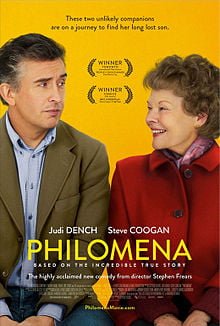
Philomena is based on a book about a woman named Philomena Lee. It’s the true story of an Irish Catholic girl who grows up in England, who becomes pregnant after a short teen romance, and is forced against her will to move into a religious convent in order to avoid the terrible “shame” of bearing an out-of-wedlock child. The film’s director is Stephen Frears, best known for The Queen.
The subject of adoption is sure to be a hot-button issue — especially for those who have either been adopted, given up a child for adoption, or parents who have adopted.
Indeed, the rights and responsibilities of bloodlines can’t be addressed with a single approach. There are no easy answers when it comes to the complex web of those separated and who wish to reconnect.
However, there are rights and wrongs when it comes to how adoptions have occurred in the past, particularly when carried out under the auspices of morality. Sadly, gross institutional injustices have kept real people apart for decades. Harrowing moral judgments held against mothers and children have caused immeasurable pain. Naturally, at the center of all this misery is the Catholic Church, once again.
The title character is played by the marvelous Judi Dench, consistently brilliant in just about every performance, and this role is no exception. Showing range we haven’t seen from her before, Dench softens her usual tough and smart typecast for a much softer and more pedestrian character, utterly believable given the very real story of this teen girl who was forced to give away her child due to the grotesque moral judgments of English society during the 1950s.
Flash forward to the present. Haunted by memories of what happened at the convent, and curious about the fate of the child she lost some 50 years earlier, Philomena enlists the help of a down-on-his-luck journalist who’s in search of a good story. Steve Coogen finds that compelling narrative in Philomena’s tale of heartache and longing to reunite. And so, her journey to find her long-lost child, now presumably living somewhere as an adult, begins.
The search takes both of the central characters across the Atlantic to Washington, D.C. where, after some painstaking investigation and a bit of luck, we learn what did become of the child given up involuntarily so long ago. We’ll leave it at that and move on so as not to ruin the surprise.
But the final mystery and ultimate conflict rest with the convent and Catholic Church, which essentially lied to everyone involved and exploited a difficult situation for maximum gain. Once again, this is based on a true story, which does grant the filmmakers an extra dose of heavy-handedness towards those who sinned.
Unfortunately, what could have been a wonderful mystery with a surprise twist, in the end, gets completely derailed by the film’s advance mixed marketing. Philomena is advertised as a light comedy-drama. However, this is very much a sad (and disturbing) movie from start to finish. A few giggles at the awkward interplay between Dench and Coogen (in the previews) in a few scenes hardly justifies the obvious attempt to draw in more viewers by making it appear this is a lighthearted film. It’s not. Rather, it’s filled with tear-jerking moments a conclusion warranting serious backlash. Perhaps even a criminal investigation and a civil lawsuit.
Philomena gets an “above average” grade from me, primarily for successfully capturing the raw emotion of a mother seeking her child, and Dench’s convincing ability to deliver on that premise. Nonetheless, some of the latent political and religious messaging are grossly overplayed in this film and is utterly unnecessary. We really don’t need the Weinstein Studio preaching the liberal gospel to us in every single film it bankrolls, and that opinion comes from me — one of liberalism’s staunchest disciples.
Were there no other film to adopt, then I’d take Philomena. But during a busy season of movie releases filled with some captivating titles, there are far too many more interesting and compelling film options to stand in line for this movie, which should be long gone from theaters by Christmastime.






For the sake of balance, I do want to just chime in and say that, were it not for Catholic Services, my parents wouldn’t have the two children they adopted. So, while I know this true story does have a tragic bent, I think it fair to say that the church has done a tremendous amount of good in the world of adoption as well, especially now that it is becoming an increasingly commercialized endeavor with a growing black market. Moreover, they continue to strongly encourage adoption as an option, something that can’t be said of some other organizations.
Obviously this is a movie and a true story and adoptions are, by nature, messy things that I respect others with different opinions on the subject, but you know me, I always have to throw my two cents in = )
I agree that Catholics Services overall has done more good than harm. This story in particular, (I saw the movie) is disgraceful in regards to what happened. The children were not harmed but the women were. I do agree that the movie had a “happy tone” to it in the previews and not knowing the original story going in, I was caught off guard when the big reveal happened. I do love that Philomena’s character was in focus. Even though she was bitterly scarred by the ordeal, she could still find forgiveness. Which I found quite incredible.