



Movie Review: Lady Bird

I ask myself three questions when writing a movie review:
1. Did I like the movie?
2. Was the movie well-made?
3. Did I gain something from seeing the movie?
Generally, if I can answer “yes” to all three questions, then I give the movie my recommendation. One or two affirmative responses means the movie is borderline. Zero “yes” answers mean I probably hated the film, assuming I didn’t storm out before the movie ended.
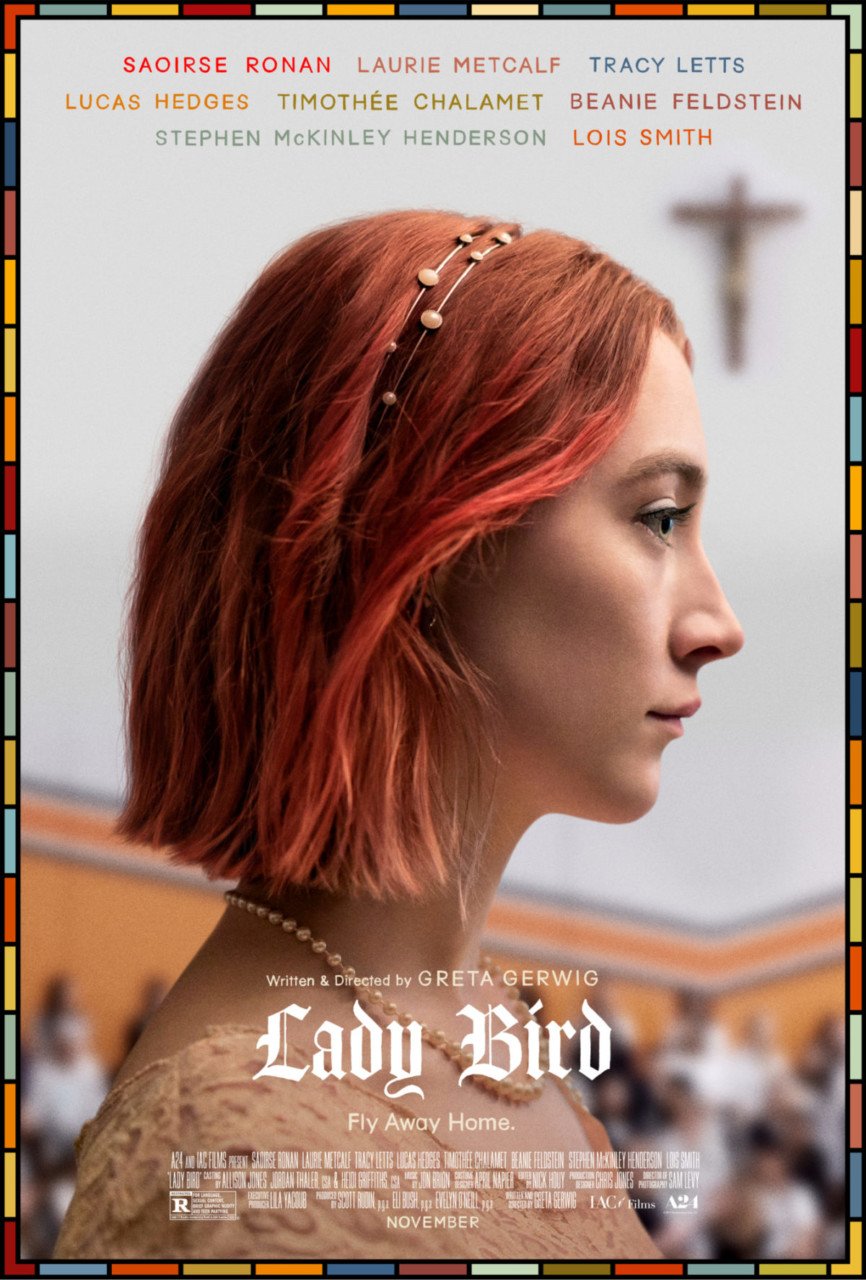
Lady Bird, the coming-of-age story of a high-school girl traversing the prototypical growing pains of late adolescence into adulthood, merits a perplexing “I don’t know” response to all three questions. I can’t recall ever having this reaction before. Accordingly, I’m confused how to grade this movie. I’m even less certain about recommending it. I suppose that all depends on who’s reading this and considering seeing it. Beauty isn’t just in the eye of the beholder. Subjectivity applies to movies, too.
Let me tell you what I liked versus didn’t like about Lady Bird.
First, here are the good things. Saoirse Ronan stars as “Lady Bird,” a self-given nickname intended as a breakaway manifesto and a flag-plant of identity. Lady Bird disdains everything about her lower-middle-class roots. So before the coming Fall, she aspires to make a clean break from her family, escape from their modest home, and get accepted into an elite East Coast college (with a scholarship, since she can’t afford tuition). She wants to get out and get even further away, which isn’t just a geographical ambition, but a chance to create something unique for herself. As dockworker Terry Malloy famously said in On the Waterfront (1954), she wants to “become somebody.”
Ronan is fantastic in this role. Coming off her Oscar-nominated performance in Brooklyn (2015), in which she played an Irish immigrant homesick for her roots and torn between love and life on two continents, this is yet another Hollywood A-List making achievement that’s established her among the most coveted actresses working in film. At age 23 at the time this movie was filmed, Ronan is entirely convincing as a teenager. She exhibits all the usual hormonal imbalances and mental insecurities. Anyone who’s been around kids of this age will nod approvingly and shake their heads out of recognition while watching Ronan on screen. She absolutely nails it.
The story takes place during Lady Bird’s senior year, at a snooty Catholic high school in Sacramento—California’s least-picturesque, most boring large city. A newly-arrived transplant to a brand new school, she’s desperate to gain acceptance with the in-crowd and join the rich and chic clique of cool students driving Range Rovers and BMWs — you know, those elites who get usually accepted into prestigious universities while kids much like herself often end up at lesser state schools or worse, don’t pursue any career path at all. Most of us remember what high school days were like. We recall students very much like Lady Bird. Indeed, some of us were Lady Bird. Hence, the audience develops an instant affinity with this lead character, which is essential to our commiseration with the film. So far, so good.
Unfortunately, the movie’s greatest strength, which is its authenticity, ends up being its most glaring weakness. Lady Bird rings so true to life, that it’s often dull, occasionally repetitive, and uneventful throughout. Sure, high school is much like that. Dull. Repetitive. Uneventful. Kids get caught up in drama class and think breaking up with a boyfriend is the end of the world. Having sex for the first time with the right person becomes an obsession. Sure, I believed every instant of each scene I was watching, and that was the problem. I don’t really care to revisit what high school was like. I don’t care to watch a high school girl fighting with her mom.
Joyous coming-of-age movies about high school kids, including Fast Times at Ridgemont High (1982), The Last American Virgin (1983), and American Pie (1999) were timeless classics because they were poignant and hilarious. As if to intentionally avoid counterfeiting previously proven formulas, Lady Bird doesn’t aspire to become either. It’s like watching a collection of smartphone videos posted to Instagram. Nothing at all is particularly memorable. Why should we care? Lady Bird could have used a bit less tedious soul searching, and a little more Jeff Spicoli. Okay, a lot more Jeff Spicoli.
That said, there are perhaps half a dozen or so moments when we realize there was potentially a great movie hidden within this wearisome screenplay. Those who are drawn to the film and the subject matter might be willing to overlook these shortfalls, or perhaps may not notice them at all. The target audience might find enough satisfaction in this slice-of-life depiction of a high school senior to give the movie an enthusiastic thumbs up. Certainly, given the strength of Ronan’s performance, complimented by Laurie Metcalf playing the role of her devoted mother and a struggling parent (who is also excellent), that’s a reasonable perspective.
My opinion is decisively in the minority. Most film critics responded approvingly to Lady Bird and complimented many of the elements I criticized, particularly about overt realism. I can’t argue with the virtues of the film nor dispel the arguments they made. Moreover, I’m also impressed with Greta Gerwig’s work, an actress making her debut here as both the writer and director. I think a piece of us wants to see young writers and directors like Gerwig succeed in their inaugural cinematic attempt, especially within a discriminatory Hollywood culture that’s traditionally closed far more doors than have been opened to young creative females. However, the bottom line is — I simply can’t overlook the dramatic and comedic void that was Lady Bird. I’m sorry. I was bored.
I expect many readers will disagree strongly with my assertions and conclusions. Many viewers in the older matinee audience where I saw the film seemed to be quite pleased. Nonetheless, I’ll stick with my gut reaction. I give Lady Bird a 4.5 score on a scale of 1o, based largely on strong performances by Saoirse Ronan and Laurie Metcalf, which can’t overcome a stale plot and little left to ponder once we’ve departed the theater. If Ronan and Metcalf weren’t so compelling to watch, I might have walked out.
Movies based on the lives of unzipped teens might be fun when we’re laughing with them and at them. Otherwise, they’re about as boring as attending high-school graduation when you don’t know anybody.
If you’re a young girl or the parent of a teenage girl, then go see it. You’ll probably answer “yes” to all three of my questions as to what makes a good movie. Everyone else — skip it.
ADDENDUM: I was concerned that my reaction to the film was negatively impacted because of my gender. So, I asked Marieta (my wife) if she enjoyed the film. She did not. In fact, Marieta didn’t care for the movie at all. Hence, I’m willing to go out on a limb just a bit and assert with some confidence this is a niche movie that probably appeals to a select minority.







> Sacramento—California’s
> least-picturesque,
> most boring large city.
Gee, thanks, Nolan. If you’re ever in the area, you’re still welcome to my guest room. Maybe I’ll show you a sight or two.
Nolan Replies:
Been to SAC a few times. Nothing wrong with it. Kind of like Des Moines. Nice city. Nice people. A bit too much suburbia and strip malls, but that’s America. I think SAC gets a bad rap because all the other big California cities are so marvelously interesting and picturesque. Okay, except for Bakersfield.
— ND