Mentors of Ideas
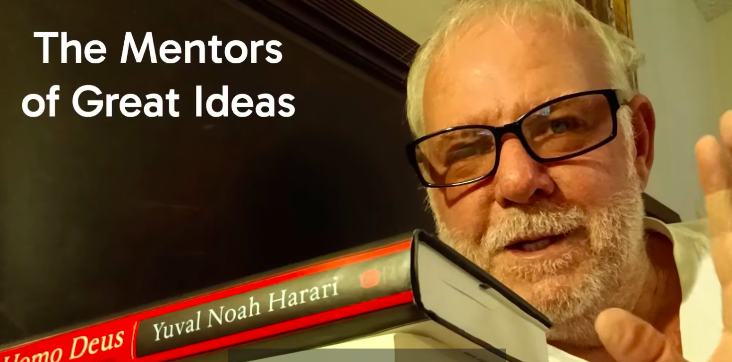
It’s important to have mentors. This is true in real life among those people we know personally — such as family and friends and associates. It’s also true with the most influential people we look up to in our society who make us all smarter, or at least provide fresh new perspectives.
I was in a discussion recently about mentors of ideas. That’s a phrase I’m applying here to describe people I’ve never met, but who are well-known, and consistently compel us to think, as well as broaden our horizons. In short, they have made millions throughout the world much smarter, and even entertained us with ideas (even if we don’t agree with them all the time).
In no particular order, I hereby offer these SIX popular writers and thinkers who have been important mentors of ideas for many years. I have most of the books they’ve written and I should probably do a retrospective on each of them at some point:
– Yuval Noah Harari — His work is expansive and he might be my most-admired social commentator and favorite public intellectual working today. Based in Israel, Harari’s numerous writings, interviews, and musings on everything from history to politics to science to high tech is often mesmerizing. I first became aware of YNH about 15 years ago when he released “Sapiens: A Brief History of Humankind” followed by “Deus: A Brief History of Tomorrow.” Everything he writes and says is worth listening to (and I should share more of his thoughts).
– Sam Harris — Sam Harris’ podcast ranks as my favorite. I’ve been a listener for a decade. He’s always engaging and attracts the greatest minds on many subjects, often in a combative but civil debate format. I’ve always admired Harris’ vanguard activism as an anti-theist (ne atheist). His writings and speeches on religion and similar topics alone would make him a “must” read and listen. However, his more recent expansion into political, social, and cultural issues makes heading Harris’s words even more mandatory.
– Heather Cox Richardson — I only learned about HCR in recent years, mostly through her daily blog/writings/email newsletter which is a blend of American history and contemporary politics and controversies. She’s widely known to many as a historian, but often brings events of the past to life in the sub-context of modern world events. HCR is consistently interesting and always timely. Subscribe to her daily narrative, and I promise — you’ll probably learn something new and often fascinating every day.
– Neil deGrasse Tyson — The popular astrophysicist might be the most watchable and readable thinker and communicator in America today. Whatever subject he covers is always interesting. But it’s his capacity to address so many different issues and talk authoritatively, yet keep things simple, that’s his calling and his gift. For instance, I know almost nothing about science or biology or astrophysics, yet deGrasse Tyson somehow distills the most complex questions about the universe into words and ideas that are informative, entertaining, and even fun. His wonderful sense of humor, combined with a natural gift for teaching, makes deGrasse Tyson a national treasure.
– Malcolm Gladwell — “The Tipping Point” was a major literary event, enabling millions of us to look at subjects we thought we knew, and view them in new ways — make that, very different ways. His many popular books since then have repeated this theme, taking familiar subjects and funneling them through a new lens of perceptions, though nothing he’s written seems repetitive.
– Robert Caro — Caro is the foremost biographer of our time. His masterful work “The Power Broker” (Pulitzer Prize winner 1975) may be the finest political biography ever, and his 4+ look series over the past 45 years on the life and impact of Lyndon B. Johnson is arguably the most dedicated commitment to a subject in modern history. His writings (and other projects) relating to Robert Moses and LBJ are, in effect, the definitive written accounts of both New York City and Texas — which is remarkable given how contrasting these subjects are which have been the focus of his life.
Now, it’s your turn.
If you will, share your 1, 2, 3….or more “mentors of ideas” and tell us why they were important and what they meant (or mean) to you.
Note: I am concentrating on LIVING persons. If we discuss deceased and historical writers, philosophers, and thinkers, I believe that’s too broad to address in a single post. Perhaps we’ll tackle that question later.
Thanks to many of you for sharing!
Note: This video runs about 13 minutes. I believe I made a few mistakes and mispronunciations, which hopefully you can forgive. I didn’t want to have to stop and record again.