



Unfit for Television: Review of Netflix Documentary about “The Biggest Loser”
“Beauty is only skin deep “
— an old fable
A new documentary about the once-controversial hit television show, The Biggest Loser now ranks as Netflix’s top program. Against my better judgement, I decided to watch it. To my surprise, I’m glad I did.
Titled Fit for TV: The Reality of The Biggest Loser it’s a three-part series detailing the origin, rocketing rise in popularity, internal scandals, and ultimately the disgraced downfall of a reality television series that ran on NBC for 12 years. Billed as a weight-loss competition, the program spawned several copycat reality shows in other countries. Licensed “Loser”-themed merchandise even netted more than a billion dollars in profits worldwide, monies indirectly extracted from all the sweat, fat, pain, and vomit on full display each week branded as “family entertainment.” (yeah–several overworked contestants were shown vomiting during the show)
All participants were eager volunteers for each season’s new casting call. The overweight contestants–many of them morbidly obese–became de facto props and punchlines for mass amusement. But this show also manufactured legitimate inspiration for the millions who were watching. Each episode included at least one obligatory feel-good story. “Wow, the fat guy lost 12 pounds this week!” We’re compelled to ask–were those struggles and occasional successes really a positive reinforcement? Or was it the repetitive fear of public shame? These are interesting questions, unfortunately with elusive answers and ethical ambiguities.
To be clear, “good television” isn’t rooted in compassion, nor even truth and fact. Ratings spike with engrossing characters, stories, and conflict boosted by cliffhangers. While participants purportedly competed against each other, in reality, the tougher battles took place within themselves, inside those flabby bodies repeatedly pushed to their breaking points. The perpetual struggles within those calorie-addicted minds habitually and hopelessly warped by the excesses of crass consumerism, while cruelly tempted by the orchestrated bait of pizzas and cupcakes dangled in front of the contestants by the show’s producers became a twisted reality-driven version of The Hunger Games all while the subjects were pummeled with mental abuse and humiliation from the show’s two maniacal drill-sergeant-driven “physical trainers. The Biggest Loser didn’t aim to create healthier bodies; no, it just wanted viewers to tune in each week and keep watching. Admittedly, it’s all a sick mutually-destructive voyeuristic display of suffer-porn. Will the starving fat girl nibble at the cupcake, or will the lucky-genes coward known as Jillian Michaels (who is the only person associated with the show who refused to appear in the documentary) be extolled as some kind of star-hero and fitness guru? More ambiguous ethical questions. Oh, and please–quit buying her shit.
In front of cameras recording each excruciating second, every physical and mental breakdown, every bitter argument, every clandestine nibble at a Snickers bar in a hidden corridor, many contestants did undergo astonishing transformations. Desperate to lose weight, the chocolate-covered carrot was a quarter-million dollar cash prize awarded to a single “winner,” who ended up losing the highest percentage of body weight. The highlight (or lowlight, depending on perspective) of each show in the long-running series came at end of each hour. Contestants paraded in and weighed themselves in on a giant meat scale in front of a live studio audience. Cheers and some jeers. It was a lumpier version of “American Idol,” powered by pounds of shed cellulite.
The people on the show had to squash all personal vanity and shelve fears of sneers and contempt. Producers purposely made the contestants appear on the show with no shirts on, and little clothing. Bodies became sculpted by intimidation, fear, ridicule, and even occasional abuse–not to mention potentially catastrophic health risks. The opposite argument goes–the extreme techniques worked, at least temporarily. More on that in a moment.
What’s to be gained by watching any of this exploitative dreck? Well, to my shock and surprise — quite a lot.
I’ve never watched reality television shows — and I mean *none* of them. Not a one. They don’t interest me. Sure, I’d heard of The Biggest Loser, but until this documentary I’d never watched anything related to the series (full disclosure: my wife Marieta wanted to watch, so I found myself a reluctant viewer at first, then I was gradually drawn in by the more human drama).
Listening to their stories, one by one, I became sympathetic to their tears, I also learned a few things. I was stricken by just how disheartening and demoralizing it is to be a heavy person in our society, even though we are a population of heavy people. In a culture maniacally obsessed with youth and fitness, we’re also getting older and heavier. Stats reveal that 45 percent of America is overweight. Nearly a third are classified as “obese.” Since The Biggest Loser first aired 20 years ago, those percentages have DOUBLED from before. The problem is getting worse. So much for “inspiration.”
The mixed messaging doesn’t help. One second, television runs commercials for Whoppers and Big Macs, then next bombards us with a new weight-loss miracle drug. Greasy cheeseburgers one moment, a magic pill to make the fat all disappear the next! This is sick. No wonder we’re all so confused. Greater than 1 in 10 of us is on a drug for depression, right now. And this is cultural advancement? It’s what happens when marketing and consumerism (unrestrained capitalism) gets ape-shit out of control, destroying all proper perspective.
The cost of being overweight isn’t just a matter of physical health. Studies show overweight people don’t get as many job offers, nor promotions, nor other opportunities in life. Romantically and in life partnerships, biases against overweight people are downright discriminatory–and very often cruel. Body shaming is very real, and particularly toxic among younger females. These deeply-ingrained prejudices amplified by the mixed messages of commercial advertising juxtaposed against unattainable concepts of fitness and beauty have poisoned a nation of millions, de facto creating lots of desperate souls longing for change and normalcy. Oh, and maybe a little kindness would help.
One particularly heartbreaking moment takes place when a female contestant discussed public perceptions and reactions to heavy people. She once had been a college athlete, got married, had children, then put on weight. The stresses of life took a toll and the woman admittedly compensated with food (coupled with little or no exercise). She described being frequently noticed by others while in college and thin, then gradually she became “invisible” (her word) as she strayed away from the conventional standards of fitness and beauty. And once she became very heavy, she perceived other people gradually noticing her again, but not in a good way. Pointed fingers. Laughter. Ridicule. It was a painful display of cruelty that’s become all too common.
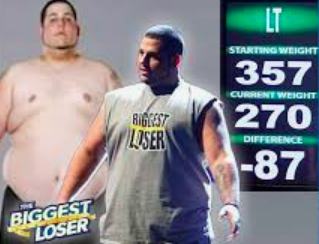
I’ll plant a small red flag here and warn readers of a possible spoiler alert: The conclusion of the documentary divulges a staggering fact. Virtually ALL the contestants who transformed themselves, in many cases losing more than 100 pounds, regained all the pounds. Many ballooned back to their previous weight within six months, and a few actually ended up heavier. The competition was only effective so long as a television show was there to motivate, inspire, and humiliate. Old habits are excruciatingly difficult to break.
The female contestant (quoted earlier in this review–above) summed up her perspectives to the grueling ordeal and experience of appearing on the show and putting her life on display. At one point, her physical conditioning program became so intense that she lost consciousness and had to be hospitalized, thus risking permanent affliction and even possible death. By the end of the full season, she did manage to shed a massive amount of weight. Family and friends kept telling her she “looked better,” which eventually came across not so much *praise for the new self* as an *insult to the old self.* She was constantly bombarded with commentary about her appearance, and assaulted with intrusive questions about her weight, even from total strangers. It seemed that everyone around her was obsessed with the outside, but no one cared to ask what was going on in the INSIDE. Pause. Absorb that please for a moment. Afterward, (she didn’t win the cash prize), the woman returned home, became mostly forgotten and anonymous to everyone around her, regained back much of the weight, and seemed destined back to square one — though much wiser for her ordeal.
“The show changed what I looked like….but it didn’t address or change who I am,” she said.
Perhaps that should be the point of it all. So many of us change what we look like and how we appear, but fundamentally we do not change who we are.







I noticed that you have posted numerous writings on Facebook since your return but because I don’t have an account I can only read a small part of them.
Hoping and requesting that you could also re-post them here on your site as well so that all can enjoy. I know its an extra effort but I think many folks would appreciate the opportunity to enjoy your writings.
Thanks for your consideration.
Also looking forward to your NFL endeavors.
Finally, want to recommend a Netflix series “Mindhunter”. An intriguing look into early FBI profiling of serial killers. Thought the acting and character development was good and interested in your thoughts on it.
As always, thanks for everything and regards,
Daniel
Daniel:
Thanks as always for the feedback and nice comments.
I’ll check out WINDHUNTER, as I almost started watching it but never dove in. I’ll give that a shot.
I post lots of stuff on Facebook but much of it is sloppy and hastily written (at least I try to spellcheck the things I post here). I’ll try to crossover more. With football starting, that will increasingly take up content. I’m also exhausted with the Trump idiot subject but it’s important to speak out, so I’ll keep on the cause.
Thanks again,
— ND
Show is “Mindhunter” Two seasons.
Holt McCallany, Jonathan Groff, and Anna Torv.
Appreciate your efforts as I enjoy reading you.
Don’t understand the Nation, all people, are not more concerned about the militarizing of our cities. They seem more concerned about Epstein. Are well all that perverted.