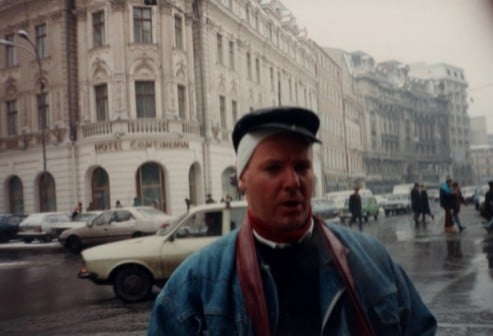
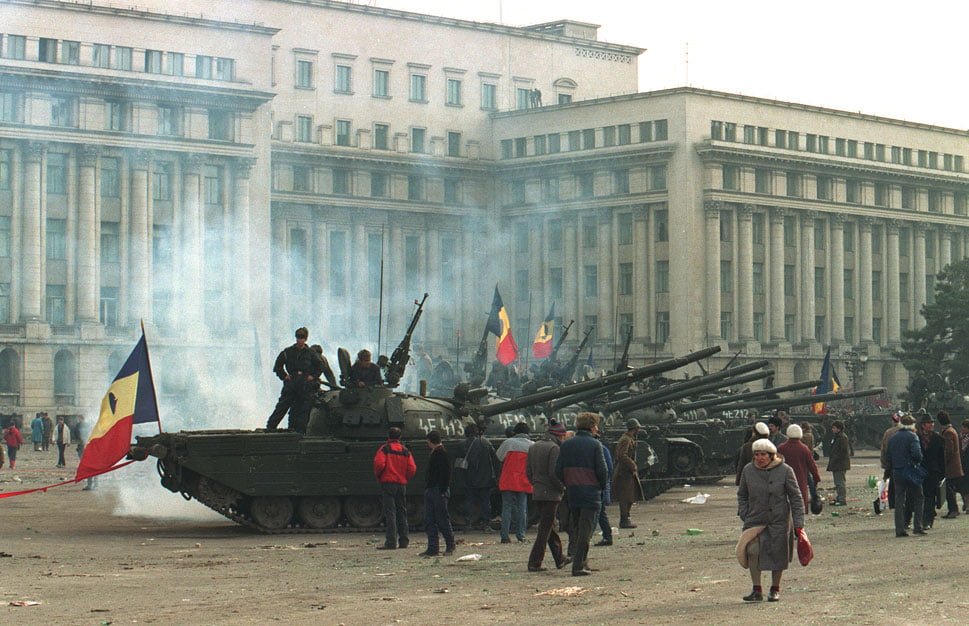
What I Saw in the Romanian Revolution (Chapter 1)
Read MorePart 1 of a multi-part series on the 1989 Romanian Revolution in Bucharest and aftermath, including my experiences.
Imagine the possibilities.
The script reads as follows: Cheech and Chong win a free trip to Italy. While traveling, the old Pope resigns and a new Pope gets picked. The two dope heads somehow stumble into the Vatican. When the new Pope finally gets chosen, white smoke is traditionally released to the crowd gathered outside in Saint Peter’s Square, and a billion cheering worshipers watching worldwide.
Cheech and Chong. White smoke. You can pretty much figure out the rest.
At least the plot for “Cheech and Chong Visit the Vatican” would make sense.
But nothing makes sense in Catholicism.
Read More

WEIGHING THE OPTIONS: TO DO SOMETHING VERSUS NOTHING
The horror of the Connecticut school shooting impacts us on so many emotional levels.
Just about everyone I’ve spoken to, or correspnded with, has endured a gambit of reactions over the past 24 hours since the tragedy — from shock, to anger, to sorrow, to (again) outrage, and ultimately (for some) to a renewed sense of determination.
Today’s column is a difficult one to write. It’s probably the most complicated issue I’ve addressed, to date. I admit experiencing a sort of “writer’s block” to this terrible tragedy, something that doesn’t strike me often. The bottom line is — what is there to say? What can be said?
But as the hours pass, I’ve come to realize that to say nothing is grossly irresponsible. To do nothing, even more so.
Hence, I shall address the Connecticut tragedy in multiple parts. First, there’s a purely emotional reaction to these unfathomable events. As one might expect, these feelings are accompanied by a demand for action. I’ve also included what I believe to be a few partial solutions which seek to reduce the frequency and severity of these horrors.
Once again, this is a terribly difficult problem to face. But we must look to these victims and honor their memory with something better than what we have now. And then, we must look inside ourselves. We must do it. We must do it now. Righteousness demands nothing less.
Why “Happy Xmas (War is Over)” by John Lennon and Yoko Ono is the Greatest Christmas Song Written and Recorded in the Modern Era
John Lennon once said he always wanted to write a popular Christmas song.
Hard to believe, but as accomplished and prolific as The Beatles were for nearly a decade, they never recorded a holiday tune.
So, less than a year after the legendary rock icons dissolved as a group, John and wife Yoko Ono fled London for a new start in New York City. That’s where they would remain for the duration of Lennon’s life. In fact, the controversial duo never returned to England again, not even to visit.
During their earliest months in Manhattan, Lennon wrote a number of songs that would later become one his few commercial flops as an artist, ultimately released as the “Sometime in New York City” album. This creative period largely fueled by intense political activism and protest included an unusual Christmas song that was inexplicably omitted from the 1972 album. And yet, it would ultimately become a powerful anthem for world peace as well as a timeless melody of hope for all humanity.
Like many great works of creative alchemy, the song wasn’t particularly well-received when released, either by critics or the public. The single wasn’t a hit when initially released in 1971 in the United States. A year later, the single was released in the U.K., where it enjoyed modest success, charting as high as fourth. But by the mid-1970’s the song was mostly forgotten.
The song did later appear on a relatively obscure John Lennon composition album called “Shaved Fish.” But following a stellar track record of commercial and critical successes — both with The Beatles and Plastic Ono Band — no one was quite sure what to make of the odd tune. It certainly wasn’t a mainstream Christmas song in the traditional sense. But it wasn’t quite a political song either, not in the mold of other Lennon classics like “Give Peace a Chance” or “Imagine.” Older people who fancied traditional Christmas music weren’t about to purchase new single by one of counterculture’s most outspoken leaders. And younger fans weren’t all too enthusiastic at the notion of listening to what amounted to a simple Christmas song. The title too was controversial, opting to omit “Christ” from Christ-mas.
Portraying historical figures on film is a daunting challenge. Such is particularly the case for beloved American icons with well-established identities.
The filmmaker’s challenge rests not so much in recreating history. Typically, plenty of credible narratives exist which provide multiple accounts of the icon’s role in history.
What’s toughest is striking the right balance between realism and art, melding history with entertainment, and doing what would seem impossible — satisfying academics, film critics, and the fickle ticket-buying, movie-going public.
This is where Lincoln, the new film by director Stephen Spielberg ultimately soars on at least one account, but fails in others.
Based in part on a book by noted presidential historian Doris Kearns Goodwin, the film concentrates on the final five months of Abraham Lincoln’s life. Surprisingly, this is not a war movie as much as an intriguing political drama. The film’s primary focus is the struggle to pass the 13th Amendment to the U.S. Constitution. That’s the amendment which essentially outlaws slavery in America (Note: To be precise, the famed Emancipation Proclamation was a war directive. It took an actual amendment to the Constitution to obfuscate state laws on slavery).
The gauntlet is laid down in the U.S. House of Representatives, where a two-thirds voting majority is needed to change America forever. Remarkably, the movement to pass the 13th Amendment is exactly 20 votes short. Virtually all of Lincoln’s advisers, most notably Secretary of State William Seward (played to perfection by the consistently-excellent David Strathairn), pleads with the 16th President to abandon the fight and focus instead on ending the Civil War as quickly as possible.
Read More