My Thoughts on Noah’s Ark and The Great Flood
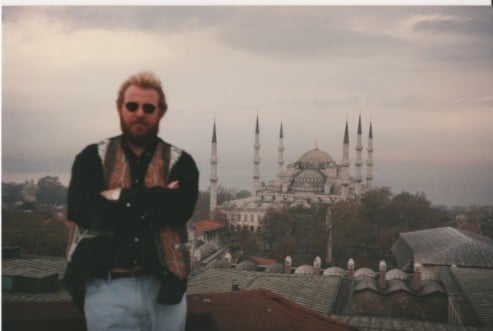
Istanbul, Turkey in 1996
Between 1993 and 1999, most of my workdays were spent inside the Turkish Embassy, in Washington, D.C.
Typical duties consisted of writing and editing official correspondence. To this day, most foreign missions along Embassy Row hire at least one native-English speaker. This is because the language used in diplomatic communications must be positively precise. The wrong word in the wrong place at the wrong time can be misunderstood, triggering unintended consequences.
I was also fortunate enough to be assigned to the public information office during that time. This put me into direct contact with many Americans who needed assistance with something or someone in the Republic of Turkey. You can’t even imagine some of the inquiries we received.
Reminiscing now, I look back fondly on those six years. What a wonderful experience that was. The Turkish diplomatic corps and embassy staff were always kind to me. Not only were they thoroughly professional at all times, they were also lots of fun to be around. I shall always have a soft spot in my heart for the Turks.
Inshallah.
***************
Of the numerous official requests received by the Turkish Embassy, one subject in particular always stood apart from the rest, because it was so unusual and so interesting.
People have been in search of the so-called remnants of “Noah’s Ark” for centuries. Those with the greatest interest include members of the clergy, academics (often with religious colleges and universities), and the media. However, only within the past 60 years or so have conditions within Turkey stabilized to the point where researchers have been granted government permission to visit and explore some of the most remote areas within the northeastern part of the country. That region in far Eastern Anatolia also happens to be highly sensitive to the military, since it’s close to the borders of two nations that have been at odds with Turkey for a long time — Armenia and Iran. Making matters worse, Turkey has been fighting a brutal separatist movement for decades that’s within close proximity, called the Kurdistan Workers Party (or PKK). Oh, it’s also about as far from the conveniences of modern civilization as you can get.
It’s easy to understand why Noah’s Ark remains such a fascinating subject for so many, for so long. For those who are religious, locating the remains of a large wooden ship in the hills somewhere, far away from the sea, would surely seem to be confirmation that the story we know is indeed true. Perhaps even validation for faith. Academics, mostly from religiously-affiliated institutions, are also hopeful the ark might be located, which (they believe) would answer questions that have mystified humankind for centuries. And, the media always seem willing to cover the true believers in search of Noah’s Ark for no other reason than it often makes for a great story. Besides, who wouldn’t want to be there with video at the instant of discovery?
***************
The real reason why the Turkish Government allows so few search parties into the region that would be of no interest whatsoever to most people otherwise is that this is the site of Mount Ararat. Repeated denials have little to do with either national security or government paranoia. Note: This is probably a bad time to state this claim given the recent developments within Turkey, which now effectively try to censor mass media. I can only speak for what things were like during the 1990s.
Fact is, Mount Ararat is dangerous. It actually consists of two large mountains — the smaller peak at 12,000 feet and the larger peak at 18,000 feet. These mountains are beyond just inhabitable. They’re covered in deep snow year-round. Most of the areas suspected to be the final resting place of Noah’s Ark are positioned along rocky cliffs, which would be accessible to only the world’s best mountain climbers. Unfortunately, most academics don’t have much high-altitude mountaineering experience. Therein lies much of the problem.
As for Turkey’s position, the last thing the government wants to be held responsible for lots of inexperienced people climbing a dangerous mountain who don’t know what they’re doing. This isn’t a typical hike with a backpack. In many ways, Ararat is every bit as challenging as what might be encountered in the Himilayas. So next time you see a film documentary criticizing the official policy of the Turkish Government, realize it’s for most of these peoples’ own good.
***************
My estimate is we received about one request per month for permission to travel and climb Mount Ararat. This was the number that came in just from the United States. I presume Turkish Embassies located in other countries too received multiple requests, pushing the final tally to a few hundred people each year who were completely serious about risking their lives to hunt for what might very well be a hoax.
One academic in particular stood out from the rest. I won’t use his real name for a number of reasons, but mostly because he didn’t grant me permission to write about our conversations (I haven’t spoken to him in over 12 years). This man published some of his discoveries (based mostly on theories) and was one of the most well-known authorities on the subject. He spent most of his adult life studying (and trying to find) Noah’s Ark. For no other reason than that, I always thought the man deserved respect, even though I didn’t agree with any of the mythology surrounding the story. Moreover, my job wasn’t to argue with or judge him. It was to help him if I could.
The man, a university professor, was absolutely convinced Noah’s Ark came to rest — not on Mount Ararat as so many believed — but rather on Mount Judi. This was hardly news to anyone of the Islamic faith. In fact, the Koran testifies Mount Judi is the actual resting place of the treasured remains.
The trouble with this alternative theory was, Mount Judi is located about 200 miles south of Mount Ararat. The direction here is important. That positions the alleged location much further away from any large body of water. It does seem geologically possible that following the great flood, water could have run off into what’s now known as the Black Sea, which lies to the north of Mount Ararat. But anyone with a basic grasp of geography would have a difficult time explaining where all the water went if a great flood carried a giant ark made of wood to Mount Judi since everything around that area remains a desert.
The bottom line is — most Christians believe Noah’s Ark is to be found somewhere on Mount Ararat. Although the incredible tale is far less purposeful in the Koran, Islam is convinced the ark is on Mount Judi.
As for me, I’m convinced it’s all in the imagination.
***************
Admittedly, I’m thoroughly unqualified to write about this subject.
First, I don’t believe the popular story as it’s been told. Second, I have no academic training, nor any subject knowledge that gives me any special insights, other than decade-old access to some key people who were experts in this field and some direct familiarity with how they were able to maneuver through the government bureaucracy. Finally, I’ve never been to either of the places alleged to be the locations of Noah’s Ark — Mount Ararat or Mount Judi. I’ve only traveled so far as Central Turkey, which is several hundred miles away.
That said, the explanations for Noah’s Ark and The Great Flood seem amazing simple, and logical. And, there’s even some scientific basis as to what really happened which now explains why so many people centuries later remain convinced that an old man with a white beard bearded a bunch of animals onto a wooden ship and survived a catastrophic flood that lasted 40 days and 40 nights.
More to come…
READ MORE: My views on the “Armenian Genocide”

The view from the top of Mount Ararat, in the far-eastern Anatolian region of Turkey.