



What I Saw in the Romanian Revolution — X. The Christmas Tree
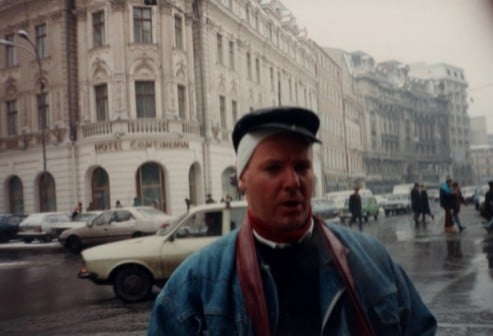
In central Bucharest, just a few days before the Romanian Revolution
This is the final article on the Romanian Revolution series, which focused on events leading up to Ceausescu’s downfall and the things I witnessed.
X.
THE CHRISTMAS TREE
Sometimes, the smallest and seemingly most insignificant things are the most indelible.
Like with Christmas trees.
Imagine a Christmas tree. Visualize the most stunning Christmas tree you can think of. Go ahead — picture it. How tall is your tree? How many lights does it have? I’ll bet the vision you’re dreaming about is magnificent.
Let me tell you about my favorite Christmas tree. It’s not what you might imagine.
My tree was tiny, even fragile. It stood only a few feet tall. Thin branches struggled to hold up a dozen or so dimly-lit white bulbs. It had no decorations. There were no angels. There was no Christmas star.
My tree could barely be seen from the outside through a soot-encrusted apartment window at the end of a dark city street. It would have attracted no notice whatsoever had it been displayed in any other major city in the world — except that on this night that lonely tree with its own special glow was displayed in Bucharest Romania in December 1989.
Reminiscing back now, it’s been 24 years since I saw that tree. But I can still visualize the hue of its magic.
Bucharest was a cold and dark place. It was colder and darker still during the winter. Moods were even more depressing in December while the entire Western world celebrated the Christmas holidays. Meanwhile, most of Romania was freezing in misery. Here, there were few signs of the holiday season.
Each afternoon at 4:30, darkness began falling over the city. A half-hour later, the city was completely engulfed in darkness. My commute home was a drive in that darkness six days a week. I typically drove from the American Embassy to my empty apartment on Strada Nicolae Ricota, a commute that took about 15 minutes.
Lenny Kravitz had just released his first album, “Let Love Rule.” I practically wore out the cassette tape on my car stereo during my morning and afternoon commutes. While Kravitz was singing his anthem of peace and love, I headed north.
Road construction forced me to take an unexpected detour from my usual route. I turned right and then left and then came upon a narrow side street. Without any warning, the smooth pavement turned instantly to cobblestones as the steel-belted radials on my Peugeot 505 began making a rickety sound as rubber bounced from the road. These were the same city streets that had engulfed horses’ hooves and carriages more than a century ago, had buttressed German tanks 50 years earlier, had paved the way for a decade of Soviet occupation, and now provided a pathway for the modern automobile driven by a low-level Western diplomat.
The road veered in unknown directions. And then, I came to realize that I was lost.
Bucharest was not a place where you could stop and ask for directions. After it became dark, no one was on the street. Shops closed. Road maps did not exist. There was no such thing as a GPS system. I tried my best to locate a familiar street or some kind of landmark. Instead, I came upon a small winding unlit street that more closely resembled an alley.
This was an uninviting road with but a single lane. The sidewalks were deserted. Apartment lights were barely visible through drawn curtains.
There, off in the distance was a familiar image I hadn’t anticipated — a remarkable sight.
I stopped and stared at that indelible image. It was a small Christmas tree displayed in the window.
In any other place, at any other time, this would have been a cheerless occasion and a depressing sight reminding me of all I was missing. But it was not. On the contrary, that lonely Christmas tree was a lighthouse amidst the darkness. An endeavor to bring joy to a place with no joy. An effort to unveil hope where hope did not seem to exist. A communique of independence where there was no dissent.
I never saw or met the family that displayed their Christmas tree on that dark Bucharest street. But the extraordinary power of that singular vision, the striking contrast between real-life hardships, and the inextinguishable virtue of the human spirit remain one of my most profound memories of life in Romania.
December 20th, 1989 may have seemed like just another typical night in gloomy Bucharest. But it wasn’t. In a small way, this was a night of profound exuberance, at a time when there seemed little worth celebrating — a precursor and a premonition that everything was about to change.
No one could have imagined this would be the final night of Ceausescu’s Romania.
NOTE TO READERS: For now, this is the final article on the Romanian Revolution series, which focused on events leading up to Ceausescu’s downfall. The next series of articles shall include several chapters of my first-hand account of the Romanian Revolution, and the aftermath. I’ll write up that series sometime in the future.
PREVIOUS CHAPTERS:






Great insightful story. I can’t wait to read more!
Have you ever thought of writing a Historical Novel about this era where your life is blended with the history and some fiction? I would read the book for sure. I like the way you write.
In some way Romania came into my heart after I visited Bucharest 10 years ago. I roamed the streets there where the Romanians struggle with the new found freedom. In an era where they were struggling to become a member of the EU (2007). You saw people were struggling with the old ways and reluctantly putting their feet in a pool of ‘freedom’.
Since then I have been interested in the history of the Romania. I even visited in Rome Trajan’s Column. The triumphal colum describing the victory of Trajan against the Dacians in the 2nd century AD.
Two and a half weeks ago I married my Romanian love.
Hello Nolan,
I just wanted to send you a quick “thank you” note for the nice way you describe Romania and the revolution. I am Romanian and I was there 25 years ago.
Merry Christmas and a great New Year!