Review: “Live Aid” Documentary on CNN
REVIEW: “LIVE AID” DOCUMENTARY (ON CNN)
If you’re 50+ (born in 1975, or earlier), you remember LIVE AID. Now, organizer/musician/activist Bob Geldof reveals the stories behind all the music, the mayhem, the madness, and the noble effort to do something and try and make a difference
Last month (July 2025) marked the 40th anniversary of the most grandiose spectacle in popular music history. In 1985, “LIVE AID,” a mega-rock concert played simultaneously across two continents and attracted the most stellar lineup of acts ever, tried to focus our attention on a faraway forgotten place with forgotten people amidst a mega-materialistic world obsessed with wealth and status. That LIVE AID took place at all in the “greed is good” eighties remains a peculiar twisted irony. Recently, CNN Entertainment wrapped up its documentary of Live Aid: When Rock ‘n’ Roll Took On the World, which reveals much of what happened offstage and when the mics were turned off — before, during, and after the duel rock concerts were held in London (UK) and Philadelphia (USA).
LIVE AID was a mess from the start. It was a clusterfuck of gargantuan egos, grotesque corporations leeching onto every possible marketing vessel, competing media powerhouses driven by superficiality, and embarrassing technical glitches rooted in two archaic football arenas–worsened by many of the iconic embittered performers taking the stage on non-speaking terms who hadn’t played together in years. After the duel concerts, rumors and controversies grew and spread including the alleged mismanagement of hundreds of millions of donations raised — albeit well-intentioned.
And yet–LIVE AID was also a massive success. The fact it’s remembered and still discussed four decades later is a testament its evergreen and perhaps everlasting influence. Even with all the mistakes and missteps, it still turned out to be far more impactful than Woodstock or other overhyped rock festivals which are now remembered so fondly, despite all their disorganization and discomforts and little else that was philanthropic or meaningful, by comparison.
In terms of global awareness and the audience that watched, no event has ever been bigger. World Cup finals and the 1969 moon walk might have been close, but LIVE AID still ranks as the largest television broadcast of all time. An estimated audience of 1.9 billion in 150 nations watched the live broadcast, more than one-third of the world’s population at the time.
A personal note: The day before LIVE AID, I drove up I-95 with a girlfriend. That Friday, we passed right by JFK Stadium in Philadelphia, driving from Washington to New York. I remember discussing the option of stopping and going to LIVE AID. But truth was, we had no idea the concert would be such a huge gathering, and memorable event (lots of acts who skipped it also had the same opinion). That decision to bypass Philadelphia and miss LIVE AID remains one of my biggest regrets. Also, I wish to note that several readers (friends here on Facebook) did attend the concerts. Most notably, my pal David Plastik was a photographer at LIVE AID at Wembley Stadium. He captured many of the greatest shots you will ever see in rock photography. Photo Credit: Plastik took the shot above and his work can be found at: CLICK HERE
Here are several short takeaways from watching the four-part series (I’ll keep them short due to limited time and space):
(1) This event was all Bob Geldof. He made it happen, and the concerts would never have taken place without his intense passion and commitment.
(2) Geldof saw an unsettling TV news report about all the starving people in parts of Africa, was horrified, and came to a decision that “someone” had to do “something.” So, *he* became that *someone.* There’s a lesson here, for all of us.
(3) One blurry film clip in the doc lasting about 15 seconds says it all, really. Geldof was attending a lightweight promo party which was a ritzy gathering London’s elite. He asks one of the other guests if he’d seen the latest news from Africa with millions of malnourished victims. The exchange is equally appalling and yet so revealing. Geldof asks (paraphrasing here), “did you see all those starving people on TV?” A rich prick holding a fluted champagne glass nods and feigns interest and then says with no break in the sentence, “oh yes, that was terrible–did you get chance to try this wonderful champagne?” The dialogue seemed straight out of “Spinal Tap,” but it was unscripted and real — and revealing.
(4) I never quite realized the direct link (actually a domino effect) between the two memorable record-smashing charity singles and the big mega-concert several months later. The song “Do They Know It’s Christmas” was recorded in 1984 comprised mostly of UK-based acts. A few months later, USA for AFRICA did a copycat song for relief titled “We Are the World.” The chart-topping successes and financial gains from those two hit records propelled Geldof and others to take the concept to an unprecedented level.
(5) Negotiating the star-studded lineups, the playing order of acts, the overlapping timing, plus the burdensome pressures of managing multiple international networks, charity components, and so many other distractions apart from the music was Herculean. Geldof really did the jobs of about a dozen executives–all by himself.
(6) Geldof (and Bono, lead singer of U2, who went on to seize the baton on pop music’s global activism in the decades that followed LIVE AID) are both Irish. This geo-political fact is no accident, nor a coincidence. Bono noted that Irish natives, and especially musicians did (and do) carry some inherent inferiority complex forced to compete in the much bigger UK commercial market and among British-run industry moguls. Rock in all places, from Tupelo to Liverpool to Dublin, has always been hard-driven by disenfranchised, lower-middle class singers and songwriters and bands who came up from the streets, and this fierce fighting yet compassionate spirit is likely what made both Geldof and Bono so influential way just beyond making music and selling records.
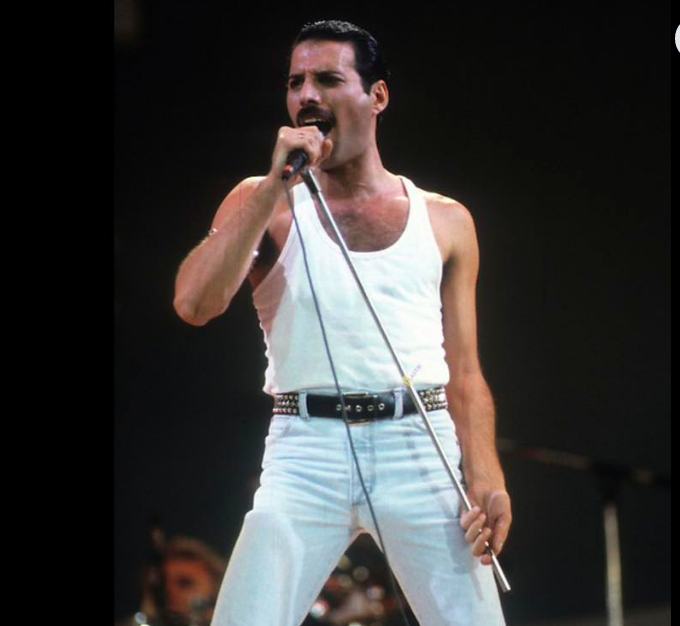
(7) Queen’s performance is still universally celebrated and according to some rankings among rock journalists stands as the greatest live performance in history (I strongly disagree with this, but the widespread reaction to Freddie Mercury and Co. is undeniable). Incredibly, Queen’s entire set clocks in at only about 21 minutes! There was even some discussion as to whether Queen should get that much-coveted 6 pm local time slot, given they hadn’t done all that much on the charts in the years leading up to the concert (“Under Pressure” a collaboration with David Bowie was their last previous hit, which had charted high four long years earlier). Geldof pushed for Queen’s spot in the lineup, knowing this performance would be something special. Given how so many of the “classic rock” bands were either terribly mediocre or in some cases really bad (Led Zeppelin, Duran Duran, et. al.), Queen was an obvious high point of both shows, though I don’t think it deserves to be cited as rock’s “greatest” performance.
(8) Phil Collins is now reportedly near his final public appearance, so it was good to see him included in the sit-down interviews. Collins was massively popular at the time and was the only artist to play on both sides of the Atlantic. Collins played Wembley, then boarded the Concorde and jetted to Philadelphia (3.5 hour flight) played a set at JFK Stadium. He also sat in as one of the drummers on Led Zeppelin’s much-maligned “reunification” performance (Note: Jon Bonham, the original drummer had died six years earlier, one of the reasons for the bands fracture and break up). The post-performance interview with Collins joined by Plant and Page in the MTV booth is painful to watch–but worth it in this retrospective. See #9 for more.
(9) I’d never heard the great Phil Collins-Cher story until this documentary. While Collins was flying across the Atlantic on the Concorde, he saw Cher (then mostly doing acting, but still memorable too for her music). Cher had not even heard of LIVE AID and had no idea what was going on. So, she asked Collins how she could go and get involved. It’s hard to imagine something like this happening today, but Cher got off the plane, accompanied Collins to the stadium, and can later be seen onstage singing in the chorus. That story kinda’ illustrates what LIVE AID was all about.
(10) Geldof and organizers wanted the three surviving Beatles to re-unite onstage for the grand finale in London and it might have happened except that when George Harrison –who had started the entire *rock for charity* movement with his iconic “Concert for Bangladesh” in 1971– was approached, he was treated like some backup bandsman. Harrison was told he’d be playing guitar on a classic McCartney song, not exactly the “group” effort one would have hoped for. He declined (Starr probably would have performed if given the chance). Why they didn’t give McCartney 3 songs, Harrison 2 songs, and Starr 1 song in perhaps a 25 minute set will forever be a lost opportunity. Turns out, McCartney closed the show on piano (alone until a mishap). He performed “Let It Be,” but the first two minutes of the song are inaudible because of a microphone glitch (neither the TV or live audience heard any of the vocals). The crowd knows every word to the song, of course, and begins singing, which is a nice recovery, but still aggravating. A few other musicians come onstage (with live working microphones) and try to salvage the moment. Umm, why didn’t anyone RUN OVER TO THE PAINO and hand McCartney a working microphone once the tech malfunction was known? Anyone think of that? Perhaps it was just too shocking at the time and no one knew what to do in front of nearly 2 billion people.
(11) I keep on writing about Geldof, but this really was his moment. Throughout the documentary and interviews, he comes across as exasperated, bitter, and even angry at times–and this was many years later. Given all the bullshit he went through and superegos he had to navigate, we can understand why he remains emotionally wrecked by the massive project (remembering that he had no experience at organization or management, certainly not on this mass scale). One of my favorite moments of the live concert is when Geldof is pacing the backstage area insists to the stuffy suits and marketing “experts” that they show a video on the giant screens inside the stadium(s) and on TV showing the terrible famine in Africa and what the charitable cause was *really* all about. Networks and several sponsors protested and say that disturbing images of starving children and flies buzzing over famished bodies in the middle of a rock celebration would dampen the mood. Geldof basically turns to them points his finger and says, “play the video, or this fucking concert is over right now!!!” Networks backed down, and once the images went live, money began pouring into the charity.
(12) LIVE AID raised a whopping $150 million in contributions, then the most-successful charity event of all time. Geldof never profited in any way from his work (and his musical career actually trajected downward afterwards). He made a controversial decision to administer the charity funds independently, rather than through a government or international relief agency. Geldof hoped that bypassing a layer of bureaucracy, more funds would go to where it was needed. Trouble was, many of the recipients lived in war-torn regions ruled by corruption. So, again, Geldof had to make some “deals with the devil” to get the money, food, and relief to the victims. Recently, I was on the phone with rock journalist Earl Burton about this, and he explained the dilemma perfectly. “It’s like building a project in New York City….you have to pay off the right people to get it done.” That’s pretty much it–Geldof had to grease some palms to make a difference. We might not like it, and critics will criticize, but results are what matters.
(13) One final extended thought: Geldof is shown afterwards flying on a private jet to Africa, meeting with officials, relief workers, and the victims. Admittedly, this is a really “bad” look. Successful rock star jet-setting into Ethiopia, Sudan, Somalia, and Eritrea. Also smacks of the “White Savior” syndrome. However, Geldof points out there were no commercial flights to most of these areas, so flying on an expensive jet was the only way to get there. And–he did put his feet on the ground and do the work. It’s sickening that many continue to criticize this noble effort. Usually that cynicism comes from selfish, lazy, indifferent critics who have done NOTHING for any cause other than themselves. Remember that and consider the source going forward.
To be clear — Live Aid: When Rock ‘n’ Roll Took On the World is *not* a great documentary. It doesn’t rank in the top of any music-related storytelling that I’ve watched. It’s flawed, and drags at times. Way too much time is spent on some topics that don’t matter so much. Yet, it’s also a fun look back and far more important — historically, musically, politically and culturally significant — because it gives us a much greater understanding (and appreciation) for what really happened. Perhaps too, it’s a blueprint for activism and change and humanitarianism, and something we can all learn from going forward.
And yeah–some of the performances were great, too.