
What happens when words or phrases lose their shock value? Are they still considered curse words?
AN UNCONVENTIONAL CONVENTION — EDITION 180
New Topic: Has profanity become passe, and what will curse words be like in 25-50-100 years?
Today’s discussion was inspired by my Facebook exchange yesterday with another writer (James Fell) about the common use of profanity. I’ve thought more deeply about this and been theorizing as to how language and cultural norms change. We’ve seen astonishing rates of evolution on many social fronts, and inappropriate language is now undergoing its own metamorphosis. Your own personal threshold of tolerance for vulgarities aside for a moment, let’s all agree on the following — what used to be *taboo* is now very *normal.*
Allow me to theorize here. Obviously, there’s more to this question as it has more meaningful implications than merely offending a few prudes.
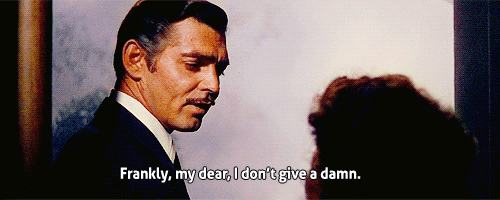
Back in 1939, movie audiences gasped when Clark Gable uttered the memorable closing line to Gone With the Wind. Hollywood’s most popular actor used the word “damn.” Gasp!
We’ve certainly come a long way in 83 years, haven’t we? Now, presidents gratuitously use profanities in speeches. News programs no longer bleep-out curse words. Even school children swear like truck drivers stuck in rush hour traffic. Fact: Cursing is normal.
This isn’t a moral judgment inasmuch as a cultural observation. And so the question becomes — what happens when words or phrases lose their shock value? Are they still curse words? “Damn” and “hell” shocked a majority of people a century ago. Today, almost no one would be offended. Will people be using “fuck” and “fucking” and all its colorful derivatives in normal conversation in the future?
Here’s where the subject gets really interesting. If current curse words become passe, then WHAT WORDS will replace them? Remember, for a word to be taboo, it must offend those who are present. It must turn heads, or in some social situations cause ostracization. For many reasons, the sharp blade that once speared curse words has dulled. Now, young people refer to something good as “that’s the shit.” Girls sometimes refer to each other as “bitches.” Friends and colleagues call each other “fuckers.” If you doubt this, you’re not living in the real world.
Oddly enough, some words that are very offensive are not commonly classified as “curse words.” Take “nigger” and “faggot,” for example. I have no way to prove this, but in a crowd of strangers if I were to use the word “fuck,” few bystanders would be offended. But if uttered “nigger” or “faggot” in conversation, some listeners would be shocked. I also presume some would walk away and avoid me (the offender) altogether. So, those words truly shock and offend.
Political correctness plays some role here in popular attitudes. While traditional curse words have lost their impact, those words that were used so freely in many circles — even within the mainstream majority (such as racial epithets) — are now taboo.
So, what is the directional arrow of cursing in pop culture? What words will speakers and writers use when they want to express an expletive? Will the time come that Martin Scorsese’s The Wolf of Wall Street with an astonishing 506 “fucks” airs on ABC on Sunday night right after a Disney cartoon? If today’s curse words become normal, won’t they (by natural cultural evolution) be replaced by something else that’s taboo?
I look forward to reading and learning if you care to share your thoughts. CLICK HERE
Note: This is the ONE-HUNDRED AND EIGHTIETH edition of A.U.C., a series that began about 3 years ago designed to foster civil discussion and constructive debate. Thanks for participating.