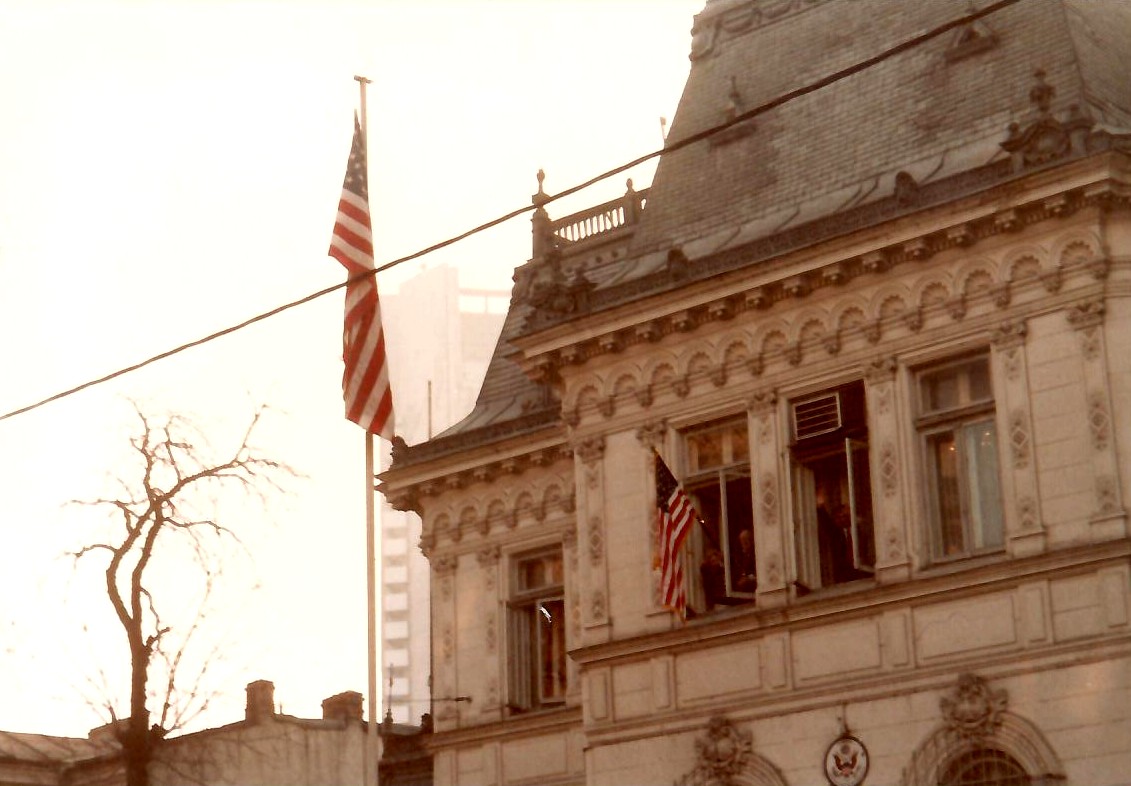

AMERICAN EMBASSY BUCHAREST,
ROMANIA (1989)
Living abroad changes one’s perspective. Those who have spent any significant time overseas in other countries will attest to returning home and then never quite seeing things the same way. This is true for veterans, for students, and for diplomats.
When we return home, I think we tend to appreciate some things a bit more. Way more. If we’re being honest with ourselves, I also think we recognize our own deficiencies. We experience things and meet new people and come to realize that some cultures and countries quite simply do things better than we do.
I lived in Eastern Europe from the late 1980s into the early 1990s. I was assigned to the American Embassy in Bucharest, Romania as a diplomat. Let me say something important: When you move aboard and represent your country, trust me — you change. It was instilled in us that when we were attached to the official diplomatic mission in a foreign country, we -de facto- become representatives of all Americans. Those locals we meet might not meet another American. So, it was important to leave a positive imprint. Even though there was officially only one true ambassador, in essence, we were all ambassadors.
This responsibility was heightened by living in a communist country. Not just any communist country, but the most repressive of any Eastern Bloc nation (aside from Albania, which was a basket case under Enver Hoxha). I’ve written extensively about some of these experiences of living in Ceausescu’s Romania in the past. All these years later, I consider those times to be incredible, lucky, fascinating, wonderous, difficult, impossible at times, and ultimately transformative. One cannot live in a society like that, witness history in the same city, block, and room, and not come away with a tremendous sense of pride and humility.
I lived on the north side of Bucharest. My five-bedroom apartment (I was single at the time) overlooked the city. Really, it had FIVE bedrooms. Plus, two balconies. I’ll post some of those photos later. I drove my Peugeot 505 to work at the American Embassy on Tudor Arghezi, which is a street named for a Romanian poet who specialized in stories for children. Sometimes I took the Bucharest subway, just because, well it was a mind-bogglingly cool thing to do.
So, what’s this photo about?
What you see is the top floor of American Embassy Bucharest on Tudor Aghezi. If you look very closely, you will also see some interesting things:
(1) Note the open windows, despite this being shot in wintertime. These old buildings got stuffy. There was no central heating or air conditioning. So, they were beautiful to look at, but really uncomfortable to work in. If you really look closely, you can even see a window AC unit. Bucharest got hot and humid in the summer, so this was one of the few AC units in the city. You never saw AC units anywhere in the city with locals.
(2) You can see the Great American Seal, which is directly above all the entrances of State Department buildings (most of us worked for the State Department, though there were USIA, DOD, and -unofficially- CIA personnel). The windows opened up to the Ambassador’s office.
(3) The American Embassy building was actually a converted palace designed by the famous Swiss architect Pierre Louis Blanc. When the communists seized power in Romania in 1945, they took control of the palace, which had belonged to Romania’s biggest banking family. The building was converted into an embassy soon afterward.
(4) There were two faces and figures in the front windows. One is Amb. Alan “Punch” Green, who I worked for. In the 1988 election, he ran President George Bush Sr.’s Oregon presidential campaign. When Bush won, Green was rewarded with the Ambassador to Romania position (more on this later, which is a great story about his wife–more photos later). The other person is hard to identify. I would guess this is the Deputy Chief of Mission (a.k.a. the “DCM”) who was Larry Napper. DCM’s really ran the embassies, as any State Department vet will tell you. I got into knock-down drag out fights with Napper, who always won, and he once even threatened to have me handcuffed by the Marine Security Guards. Yes, true story. After serving as DCM in Romania, Napper was rewarded and became the American Ambassador to Latvia, and later Kazakhstan.
(5) If you really look closely behind the embassy in the photo, you will see the grey outline of the Intercontinental Hotel. This was the centerpiece of Bucharest, anchored dead center in the heart of the city. During the communist era, Securitate (the Romanian secret police) bugged every hotel room, since foreigners were the only people who could afford to stay there. The top two floors had huge camera canons and sound equipment targeted at every major Western embassy. It was like having the “eye in the sky” over your every move. I still remember being told when I arrived for my two-year assignment — “assume you are being watched and listened to every second of your life, because YOU ARE.”
I cannot remember the date of this photograph. I presume I took it sometime just before the Romanian Revolution in December 1989. Since the Ambassador has an American flag displayed from his office window, my guess is it’s Veteran’s Day 1989, which most Europeans celebrate as “Armistice Day.” It was taken out in front of the main entrance, from the street.
The American Embassy you see here was abandoned a few years later. It’s now for sale. Asking price: 5.5M Euros. Once the communist government was overthrown, the State Department constructed a new embassy compound on the periphery of the city. I know there are security concerns and reasons to move and be more isolated, but I think we lose something when we’re not part of the city, its people, and its culture.
After all, we’re supposed to be ambassadors.
Here’s a shot of today’s American Embassy Bucharest:

