
THE STORE THAT CHANGED US:
SAYING GOODBYE TO THE DOWNTOWN DALLAS LANDMARK KNOWN AS NEIMAN MARCUS
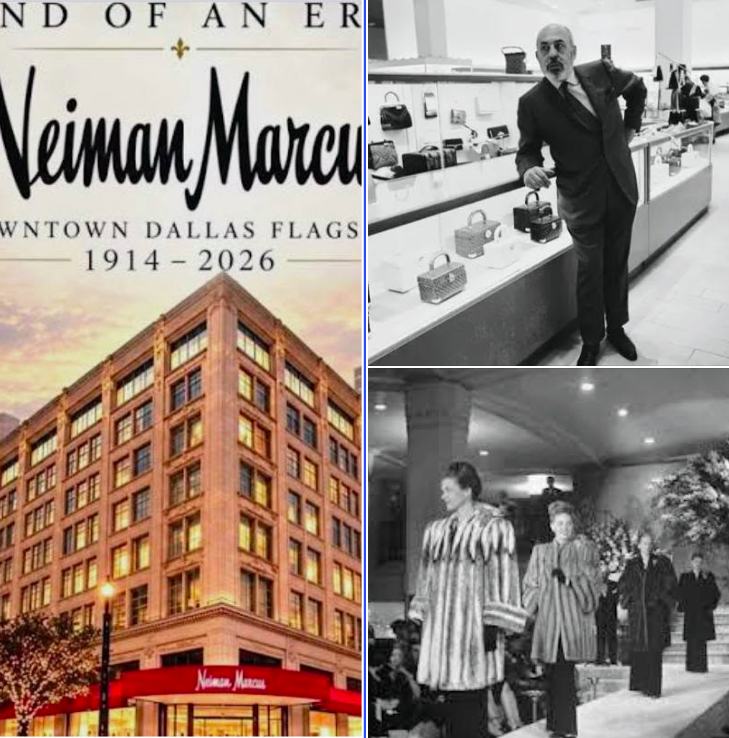
I was saddened to learn that Neiman Marcus, the flagship store in Downtown Dallas, closed its doors for the final time, earlier this week. It first opened in 1914. It closed down for good on Sept. 30, 2026.
What a remarkable history.
They survived two world wars, a depression, multiple recessions, ups and downs, booms and busts, and a presidential assassination just a few blocks away.
If you grew up in Dallas, Neiman Marcus wasn’t just a department store. They weren’t just about window shopping and gawking at sophisticated clothes and fancy jewelry. It was an institution. An aspiration. A dream. A palace. It stamped one’s arrival.
Around 1980 when I graduated from high school, my mother took me to that store. She bought me a new wool blazer. I remember wearing that fabric with pride — because it was from Neiman Marcus and it was given to me by my mother. How special is that.
Neiman Marcus was elegant. It was cool. It was chic. It was traditional. Yet, it was always forward-looking and boldly progressive. You could be whatever you wanted it to be, provided you could afford it. Even those who could not afford to shop there, ultimately benefited from their undeniable influence and impact — on politics and economics and culture. For it’s most lasting legacy may have been extraordinary contributions to changes in American society that desperately needed a respected voice to lead, and to fight for justice, and to do what was right.
Early Dallas retail was dominated by notable Jewish families, who modernized cities all across Texas and throughout the South with fashions that rivaled anything in Paris and New York. Neiman Marcus, Sanger-Harris, Zales, Joske’s, Sakawitz, Frost, E.M. Kahn, Titches (Titche-Goettinger), and Jos. Linz clothed the Dallas elite, while Foley’s, Battlestein’s, and Weingarten’s did much the same in Houston.
Selling clothes to rich people may seem superfluous, but Neiman Marcus did so so much more than that. They eventually expanded to 43 stores nationwide. Their name and brand became synonymous with style and elegance. Fashion shows were media circuses. The Neiman Marcus catalogue annual release was a major event — The Tonight Show” with Johnny Carson did comedy skits on the special featured gifts every year, which was always something wildly outlandish. One of gifts was your own service robot (price $100,000), and this was back in the 1970s.
Neiman Marcus also designed and made the famous World Series of Poker gold bracelets for nearly three decades. Those became the hallmark accomplishment of the game, coveted worldwide. The late Benny Binion had remembered growing up in Dallas in the 20s and 30s and Neiman Marcus being the finest store in town. So, after he became one of the early Las Vegas casino pioneers, he called Stanley Marcus personally — and the rest, as they say, was history.
Stanley Marcus was the consummate world-class gentleman. He just looked ” the part.” Like straight out of central casting. Born in Dallas, educated at Harvard, he was the man. I met “Mr. Stanley” once, and even went to his house where a least a dozen people were working inside on latest fashions (I knew his live-in valet and got invited there sometime in the mid-80s).
Stanley Marcus was entirely secular, and probably an atheist. He was often labeled as a businessman-intellectual in numerous features on his life and career, a man who became bountifully rich by selling sophistication, but always retained a deep social conscious and sense of responsibility to others — be they customers, his employees, or even complete strangers.
There’s many examples of this. I’ll share just one: Neiman Marcus’ famous Zodiac Room became the first fancy restaurant in the city to desegregate. Imagine the shock of affluent White Dallasites when they first saw Blacks dining inside the flagship Downtown Dallas store. Marcus’ work on behalf of civil rights and struggles may have been inspired by his own earlier experiences growing up different, and a minority. He certainly carried those lessons of life forward. Stanley Marcus died in 2002 at age 96.
When Neiman Marcus opened a new store in Washington, I remember dining there many times (it was walking distance from my home). The food was exceptional, and remarkably cheap. It was almost like the retail store operated like a casino — create a reason for customers to come in the door (which was always upstairs where you had to walk past all the goodies), and they’ll certainly look, and a few will even buy something. Brilliant. The best marketing is to make them walk and look — and dream. Today, there are seven Zodiac Rooms (in other locations), and a cafe inside every NM store, including the one here on the Las Vegas Strip.
The company was sold off to New-York-based Exemplar Luxury Group a few years ago. That ended the famous family’s connections. It retains the famous name, but I expect the things that made it truly special to gradually fade and disappear.
Today, we may think of Neiman Marcus as just another fancy store for the rich, and a hangout for people with too much time and money. But, they really did change things. What power and influence Neiman Marcus wielded over more than a century became a conduit of progress and force of good.
The Downtown Dallas location wasn’t just a store. It was a monument to lots of fond memories.