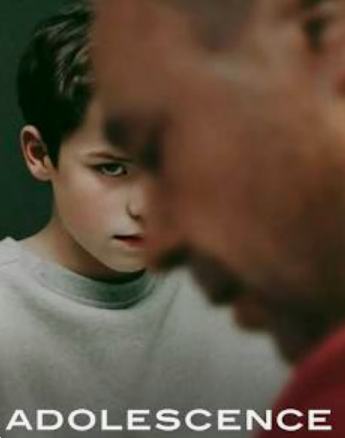

NETFLIX REVIEW: “ADOLESCENCE” (2025)
British-based Netflix crime drama is a cinematic masterpiece and acting tour-de-force–contemporaneously shocking, depressing, mesmerizing, excruciating, and yet so profoundly troublesome.
What’s now happening to our young people?
Answering that question could be much scarier than we realize.
Adolescence comes as both a stark warning — and a shocking revelation. It’s currently the #1-most popular show on Netflix, for good reason. It stayed with me for quite some time after I finished watching the mini-series.
This is the most powerful new television show of the year, to date. It’s certain to be widely discussed and debated, far beyond usual friendly social circles and outside customary isolation chambers choked with meaningless escapist entertainment. The show and series — which is loosely based on an amalgamation of actual recent crime cases committed by teens in the north of England — is as real as it gets. It’s a story very much for our times, and an introspective portrait of youth culture which should incite a much broader self-examination that’s long overdue.
Told in four parts (each episode runs about an hour long), viewers are immersed into every frame of each second in every scene. We feel like we’re inside the room, not trapped necessarily, but still part of the story of concealment that gets peeled away slowly, one painstaking layer of truth at a time. The psychological impact feels almost claustrophobic and tiresome even, yet once we lock in on the characters and story, we can’t look away, nor can we turn it off.
<<<No Spoiler Alert–Continue Reading–Some Intentional Vagueness Coming>>>
Adolescence tells the story of a typical 13-year-old boy. He’s normal in most ways, and comes from a decent, hard-working family. He’s just like the kid down the block who rides his bike past your driveway each day, attends school, gets okay grades, plays sports, is interested in girls, plays on his computer, and does all the usual stuff that early teens get into.
However, looks can be deceiving. Things aren’t always what they seem. Maybe, things are never what they seem.
The boy is charged with murder.
— Part 1 is the arrest and takes place inside the boy’s home along with his family and at the local police station.
— Part 2 is a few weeks later takes place at the boys school, attended by kids ranging in age from 12-18.
— Part 3 is 7 months later takes place inside a room at the detention center with a psychiatrist.
— Part 4 is a year later and takes place around the small town, and shows the impact on the crime and the serious criminal charges upon each member of the family.
The reason why these episodes and scenes require some explanation lies in *how* the story gets told and how this series is filmed. My take: This is one of the most astonishing displays of cinema you will ever see. If you’ve tried to take the perfect photograph and couldn’t quite get that right, just imagine the following challenge.
Each episode is filmed in one long continuous shot. No cuts. No multiple camera angles. One single take. This stands as an unprecedented mix of technical and creative and acting wizardry. Imagine, an hour of strenuous dialogue, multiple movements, location changes, raging emotions, arguments, extras, and the usual distractions of everyday life (cars, bells, phone calls, etc.) filmed in one uninterrupted “take.” All four episodes are filmed in precisely this manner. It made me wonder how many times the crew suffered a technical malfunction or some other unforeseen breakdown on set, but still managed to plow through the scene. The movie experience we witness here is nothing short of……breathtaking, though it’s executed so well that we don’t even think about the filming technique after a few minutes. It’s so easy to lose ourselves inside the rooms, absorbed by the characters, in each scene. The closest comparisons I’ve seen in a movie to this unusual film sequence were the astounding war scenes in Children of Men (2006), done so masterfully by director Alfonso Cuarón. But those scenes lasted around 10 minutes. Done four times at 60 minutes in each shot, this may be even more impressive.
Note: Be sure and watch the final 10 minutes of Episode 2, which shows a foot chase outside the school. Sting’s “Fragile,” covered so hauntingly by a child’s choir, plays over the soundtrack. Watch the camera work on the closing scene (and remember the filming actually started 55 minutes earlier, with no interruptions). If you don’t watch all of Adolescence, at least tune in to this scene. It’s brilliant.
Credit veteran British actor and producer Stephen Graham for this stunning cinematic achievement. He co-wrote and produced the series. Graham also co-stars as the accused boy’s father (and is spectacular as the anguished plumber who can’t believe his son would ever commit such a hideous act). The entire cast is magnificent, but Graham deserves some kind of award for this level of originality and excellence.
Aside from the mesmerizing camera work and superb acting, what really makes Adolescence so engaging yet also so difficult to watch, at times, are the troubling implications of teen culture in the modern age of social media. Normalcy hasn’t just been time-warped–its been upended and demolished. To say kids “grow up too fast” might be the grossest understatement of this generation. Often alone and confused and forced to somehow navigate the trials of adolescence, many boys (and girls, too) are now latching on to some horrifically bad influences, which are out out there in abundance and far too easy to find. The toxicity of the most popular “influencers” on social media, often with millions of impressionable followers, is certain to produce some devastating consequences ahead for us all. This isn’t just innocent fun, nor a normal part of phasing from boyhood into becoming an adult. It’s a prescription for mass dysfunction and eventual disaster.
These kids grow up. What then do they become? I’ll leave the social messaging at that, so as not to ruin any suspense. Nor, start a political war.
My only criticism of Adolescence is, it may have been overly long. The final two episodes (Parts 3 and 4) don’t quite have the same impact as the earlier parts of the story, when we didn’t know as much about the crime. Perhaps Parts 1 and 2 were just so moving emotionally, that it became impossible to sustain that same level of invested captivity. I also found the final two parts to be woefully depressing. WARNING: This is *not* a feel-good show for the whole family.
Nonetheless, Adolescence is a series that should be seen, and pondered, and discussed. Unfortunately, given what’s out there, it might be too late for many. Maybe, if there’s a Season 2, the creators can address if broken adolescence can be mended. In the end, we all leave with more questions than answers.
But it sure does give us lots to think about.