
Note: This was written on Friday, the day after I voted in-person here in Nevada. On Saturday, my home was visited by two DHS agents. I posted about that incident in a video testimony of what happened. What follows here will deal exclusively with voting and my experience on the previous day.
My state, Nevada does an excellent job with in-person voting (I have never voted by mail). It’s accessible, quick, and easy. I also feel more confident in the process now having done it. Yesterday, we voted at the West Sahara Community Center. From the moment we drove into the parking lot until leaving, the entire process took 20 minutes.
We’ve voted in every election since 2004, and in most primaries. Nevada provides a wide window of calendar dates to vote — nearly three weeks long. All states should adopt a similar window of opportunity. In fact, broader extensions should be universal. Making voting difficult for registered voters is unconstitutional, yet it’s been an ugly practice since our nation was founded (intended to discriminate and disenfranchise–mostly minorities and poor). Keeping polls open for more than one day costs more, but if increased voter participation is the objective, then multiple days are mandatory.
Now, a few specific thoughts about this poll location and my experience:
1. Question: Do the hundreds of signs littering every access point around the voting station *really* change anyone’s opinion? I suppose these political signs are as much DEFENSIVE in nature as anything positive. If several candidates were NOT put up signs, that means fewer signs would then draw more attention. And, the worst thing for any candidate is to have ZERO name ID, while the opponent is a familiar name. If innumerable signs clutter up the space, no one looks or notices them. Just an off observation here about how absurd campaigning works and distorts reality.
2. Hustlers: I used to hate walking the gauntlet through the fleas who try to stick a pamphlet in your hand while walking from the car to the polling place. They used to nearly attack you, and it was usually some candidate’s rep you’ve never heard of (I guess that’s the idea). My local polling place did a really good job this year–first time I’ve seen this. They put up yellow police-line tape so voters can walk up the sidewalk without being badgered by hustlers. However, they do stand there on the opposite side of the police tape, and can be approached IF YOU want to engage them. Well done, Nevada (I assume this is a statewide rule which is enforced).
3. More about the Hustlers: I have mixed feeling about them. On one hand, I admire anyone’s volunteerism. It’s not easy standing around for hours trying to engage with strangers. People, sheesh! I get it. On the other hand, I dislike the intimidation factor. I’m pretty direct and have a teflon personality, but others who make that walk may not feel as comfortable when getting pitched and hustled by some dude pimping the Family Court candidate in District 21. Admittedly, I’ve gotten into arguments with some hustlers in the past who pimp Republicans (shocker–profanity has been hurled). The police line tape protects THEM as much as ME.
4. Check-In: Plenty of poll workers. Quick and easy. They ask your name, but most people show ID. This is a controversial issue right now (mandating voter ID). Most people just willingly volunteer their drivers license, and that makes verification much easier. I’m not sure what they do if or when someone shows up without identification, but that’s not a problem here (and it’s ridiculously overblown nationally, intended to stir up mistrust in the voting process). I was asked if I *also* received a mail-in ballot, and I answered YES. I was told NOT to mail that in (which would mean voting twice) and doing so would be a felony. I noticed everyone is told this, and it’s shown in writing when you sign the screen. Presumably, sophisticated system controls are in place to flag multi-voters. In the few cases they happen, it’s probably about equal and a cancel-out effect takes place (but that’s speculation).
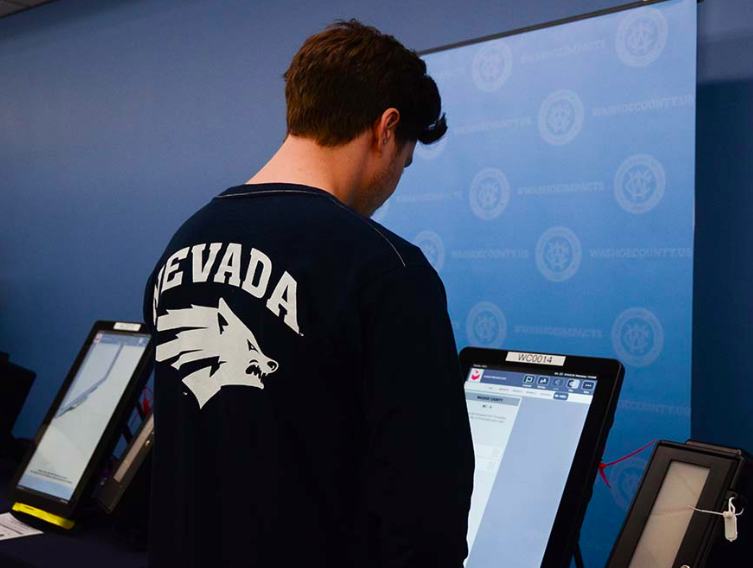
5. The Voting Booth: Here’s where a surprise happened. If you’re older, you may remember clunky old grey metal machines with a curtain that closed behind you and levers. It was the size of a golf cart with wheels. Those voting machines were used for years. I never trusted those relics, because it seemed every state had malfunctions, accusations, and controversies. This time, our “voting booth” looked more like a grocery self-check out. That’s really as close a description as I can think of. You stand there in front of an oversized computer screen with large letters (thank you!). And it’s touch screen voting. What was interesting — you can talk to the person next to you (Marieta was voting right beside me). If you crane your neck, you can also see the other person’s screen. This does raise questions about “privacy,” but upon closer inspection when you deviate just a little from looking STRAIGHT into the screen, the image becomes fuzzy. So, this privacy protection is effective. However, some voters accustomed to curtains and some obvious signs of secrecy may question this “grocery check out” process.
6. The Print-Out: After entering the choices onscreen, next we print up our own completed ballot. There’s a printer right there! Then, you take a double-page ballot that’s the size of a sportsbook sheet and take it to another station. There, it’s scanned, then held. So, it appears there are THREE records of your vote: 1. computer 2. scanned copy 3. hard-copy paper ballot. This makes me trust the process much more, as a properly supervised vote audit would reveal the proper tabulation of votes. I’m not saying manipulation isn’t possible — but here in Nevada it would take some other means to rig three distinct voting records.
7. The Walk After: It’s funny to walk the gauntlet and return to your car. All the hustlers pay you NO attention whatsoever. It’s like you become INVISIBLE after voting. The deeper political symbolism of this is not lost on me. On this day, I did stop and talk to a Democratic Party volunteer. She was handing out a tout sheet with “recommendations” on all the races. Note there was a Republican Party volunteer doing this, as well, but I did not engage that person. I told her the tip sheet was very helpful and what she was doing was important because most voters (including me) didn’t know which were the most progressive candidates, especially in non-partisan races. The write-up and post that I shared from Nick C. was also useful, as I had my phone open and voted for those candidates, mostly judges. Another observation: A local DJ was spinning records in one tent. At another, a classical guitarist was playing, though it was hard to hear with the clash of music. I didn’t see who the DJ and guitarist were with — I wonder if music sways any votes? (dubious dirty-tricks idea–set up a station and then play the most OBNOXIOUS music and then have the banner of the opposing candidate–“screw that person, I’m not voting for them!”)
In summation, this was a pleasant, educational, and satisfying experience. However, I don’t know if this us typical — nationally. Perhaps other states have much more antiquidated systems. Feel free to comment. I’ll post more in the next few days. Thanks for reading.
— ND
(This is a stock photo above–from UNR’s website. I’m not sure of photography is allowed at polling places, so I didn’t take any pictures.)