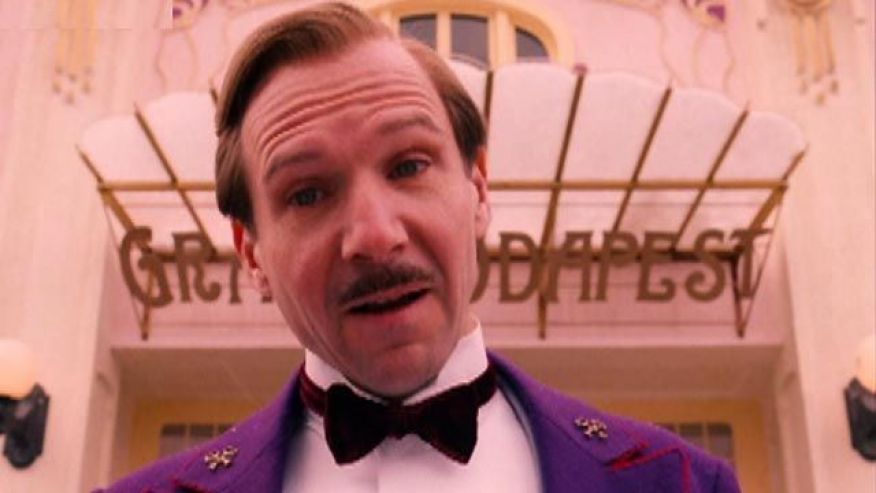
“The Grand Budapest Hotel” is unlike any film you will see (or not see) this year.
Imagine plunging Charlie Chaplin, Quentin Tarantino, and the Coen Brothers into a giant blender and then pressing “puree” for the full 101 minutes. That’s the succulent mix of zesty influences readily abundant in the latest film both written and directed by Wes Anderson, starring one of the best ensemble casts assembled for any film made in recent memory.
Anderson’s previous works as a movie director include Rushmore, The Royal Tenenbaums, and Moonrise Kingdom, each progressively demonstrating a quirky style and irreverent approach to storytelling that might otherwise be simple and predictable. But in any Wes Anderson movie, audiences never quite know what’s coming up in the next scene. This makes his films both unique and unmistakably canonesque in what’s become a definitive signature.
The Grand Budapest Hotel is the story not so much of a luxurious inn, but of the self-indulgent man and his faithful puppet-servants who somehow manage to run it successfully. Set in a fictional country in central Europe just prior to the start of World War II, the fancy hotelier also has a thing for the ladies (more specifically — their bank accounts). He juggles a stable of women. Each shares two common traits — they’re super-rich and close to the grave. Indeed, our protagonist is a conniving golddigger. who bathes in perfume and can turn on the charm at the snap of his fingers.
Ralph Fiennes is perfectly cast in this starring role. He manages to shock, offend, insult, and ultimately win over everyone around him, including the audience. Fiennes seemingly needed to land this film role or something like it and has clearly immersed himself into the nuances of a fun character. Let’s face it, Fiennes hasn’t done much good work on the screen since a string of stellar performances back during the mid-1990s, starting with an Oscar-nominated role in Schindler’s List, playing one of the most despicable villains in history.
Although Fiennes stars, the narrator of the film is actually the wonderful F. Murray Abraham (a “Best Actor” winner for Amadeus). Older and wiser now and remembering his days when he started working in the hotel as a teenager, Abraham tells the story of the now shabby hotel and its former grandness.
As the story unfolds, we’re treated to a cavalcade of well-known stars, plus a number of lesser-known character actors, which makes the movie a non-stop stream of cameos. Few of the characters are believable in the purest sense, but we just go along for the ride. What could have morphed into the camp zaniness of It’s a Mad, Mad, Mad, Mad World is instead infused with lots of what I like to call “British humor” and even a few moments of genuine sentiment. Aside from Fiennes and Abraham both of whom are excellent, the movie also includes Adrien Brody, Willem Dafoe, Jeff Goldblum, Harvey Keitel, Jude Law, Bill Murray, Edward Norton, Jr., Jason Schwartzman, Tilda Swinton, Tom Wilkenson, and Owen Wilson. Yes, I left out a few names. But you get the picture. Side Note: By the way, Owen Wilson has appeared in every one of Wes Anderson’s films. Wilson and Anderson both grew up in Houston and attended the same high school together.
The plot doesn’t seem to matter. It’s just an excuse to watch the actors deliver their funny insults and move on to the next unpredictable sequence of events. The story checks out of the grand hotel temporarily when Fiennes’ character gets involved in an ugly dispute over one of the dead widow’s estates, with the family of the deceased. Apparently, Fiennes’ charm was so powerful, the old widow changed her will just prior to death, leaving the bulk of her estate to the dapper Cassanova. This sets off a cinematic tennis match of back and forth volleying between the main characters, with the luxury hotel serving as the center court.
The film’s tone and texture can be summed up into one scene. About midway through the story, Fiennes’ character gets thrown into prison. Yet, he somehow manages to escape. Each segment of the caper gets more ridiculous than the next. It’s as though writer-director Anderson intentionally plucked out every means of escape possible from every prison movie ever made and then combined them into a long sequence of obstacles, becoming increasingly more ridiculous by the second. The movie is consistently like this from start to finish — thoroughly unbelievable, but consistently clever and funny.
If you enjoy irreverent humor and Anderson’s previous films, this stacks up well among his best work. The brand of humor isn’t for everyone. But while watching it, one senses the cast had a blast making this movie, which comes out onscreen.
I give this movie 7 stars out of 10 and a solid recommendation.