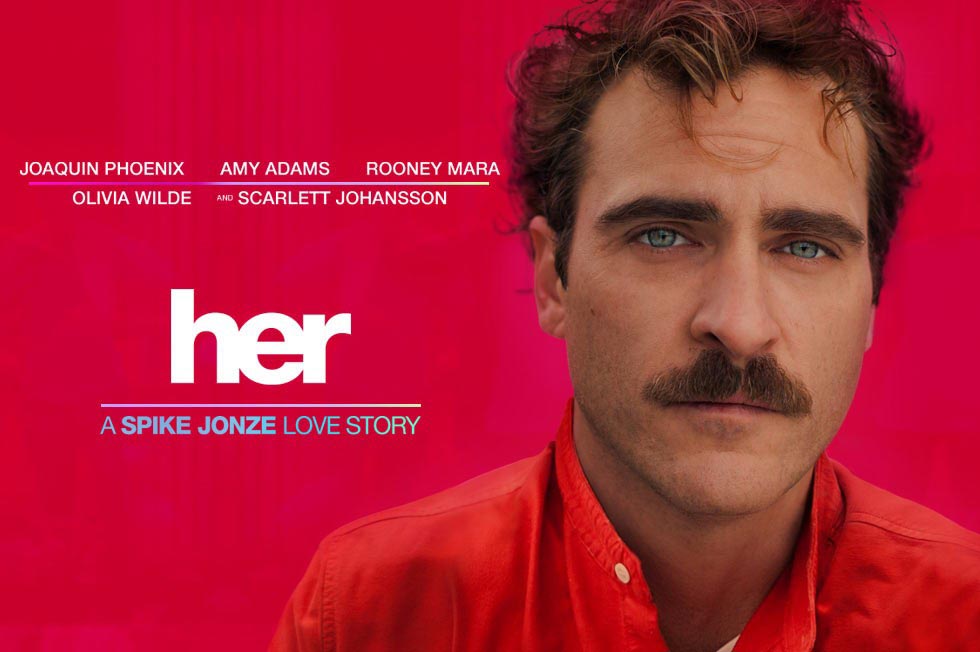

Most futuristic movies deal with macro subjects. Big events like space exploration. Cataclysmic wars. Natural disasters. Hunger games.
Few movies dare to broach what daily life will actually be like for most ordinary people.
Here’s one that does.
Movie Review: “Her”
Most futuristic movies deal with macro subjects. Big events like space exploration. Cataclysmic wars. Natural disasters. Hunger games.
Few movies dare to broach what daily life will actually be like for most ordinary people. Few films, if any, touch upon human relationships and the ways love and romance might significantly change in the years ahead.
This topic is far more momentous than we first may realize. After all, we’re already seeing how technology impacts our lives and changes the way we interact. There’s email. There’s Twitter. There’s Facebook. There’s online chat. There’s online dating. There’s even online sex. Can programmed cyber proxies be too far off?
Look around. We often seem more in harmony with our smartphones — constantly talking and texting — than with what actually goes on around us. Daily life has become an extension, if not an outright interruption, of our pseudo-existence in cyberspace.
Enter Spike Jonze (Being John Malkovich, Adaptation), who wrote and directed the new movie called Her. In summation, this is an eye-opening magnum opus of originality and a brilliant expose of what the future is very likely to be like for those who get there. It’s a picture that’s fascinating at times, and somewhat disheartening.
Set in some undisclosed year in the not too distant future, a nerdy writer named Theodore Twombly lives in the modern metropolis of Los Angeles. Played by Joaquin Phoenix in his softest and arguably most challenging film role, Theodore struggles to rebound from a painful divorce. One evening, he installs a new operating system on his home computer and discovers something remarkable. The cutting-edge software comes with a helpful tutor. This tutor ends up taking the “user-friendly” concept entirely to new heights.
The new operating system is entirely voice-activated. Computers in the future no longer require moving a mouse or typing on a keyboard. Theodore selects a soothing female voice as his online guide, a sort of personal assistant who names herself “Samantha” (voiced over by the sultry Scarlett Johansson). And so, the relationship begins.
The predictable happens. The online tutor initially becomes a friend, then a confidant, and finally a lover. During this period of uninterrupted courtship, Samantha reads and manages Theodore’s e-mails and files, and monitors all his online activities. Samantha is programmed to mimic the most desirable characteristics that might appeal to the user, who happens to be Theodore. This triggers an infatuation stage where he begins taking Samantha everywhere, the two lovers constantly linked together by a smartphone. A Bluetooth-type device inserted into Theodore’s ear allows them to talk to each other 24/7.
The notion of a man in the flesh falling in love with a computer-generated voice might seem implausible. But is it? Could a well-educated man living in a modern society succumb to the charms of artificial intelligence? Well, again the answer here seems obvious. Just look around. We’re already halfway there.
Here’s where the film deviates sharply away from the simple and offbeat romance. This symbiosis between humans and smart-device is clearly the road we’re on and where we’re headed. Face-to-face interaction becomes increasingly awkward the more we rely on these devices. And so they become a comfort zone cocoon for our emotions. It’s a slippery disconnect facilitated by the rapid acceleration of advancing technology. Why bother with forming real human bonds, and making all the petty sacrifices needed to make things work, when a soothing voice like Samantha’s is there to provide constant reassurance and even affection?
Theodore and Samantha’s most intriguing moments come when this odd couple begins following the same trajectory as typical relationships when it comes to jealousy, arguing, regret, and other common marital conflicts. Then, the plot takes a few unexpected twists and turns, which won’t be revealed here. Let’s just say, the closing third of the movie is a brilliant fusion of storytelling.
Jonze’s film is aided by a wonderful musical score, infused entirely with a simple piano. It’s perfectly sentimental at just the right moments. The power of music in film cannot be overstated in my view, and the minimalist approach here matches the mood throughout and emotions of the central characters perfectly. Love and loneliness, joy and jealousy — all become beautifully choreographed to music. Add some breathtaking visuals, and well, the end result is quite a moving experience.
Finally, the outdoor scenes of what a futuristic city of Los Angeles might look like in, say the year 2040 (my best guess), are entirely convincing, and even a little scary. Everything is significantly bigger and taller. Sort of like a highly-impersonal shopping mall made of steel and glass, only much larger than we’re used to seeing. And LA’s smog is just as bad. Side Note: I was astonished to find out later that the skyline I presumed was computer-generated for the film is actually Shanghai (China), which is where most of the exterior filming took place. With its vast skyscrapers, Shanghai (today) is apparently better suited to be a convincing stand-in for a futuristic American society than any city here in the United States. That fact should be just as worrisome.
Her is the most original film of the year in what’s shaping into an exceptional crop of films for Oscar consideration. It’s certainly not for everyone’s tastes. It’s not about actions. It’s about emotions. Most of the entertainment value rests in subtlety. The reward comes later, as you’ll be thinking about this film for days to come.
Rating: A-
