

I follow politics because it’s great entertainment. It’s the national theater of our society — and there’s a performance every day and night.
So far, I’ve watched every single hour of every single night of both national party conventions.
I follow this practice, not because I aspire to become the ideal civic-minded citizen. My motives are much more selfish. Frankly, I follow politics because it’s great entertainment. It’s the national theater of our society — and there’s a performance every day and night. Best of all, it’s completely free to watch and enjoy. Then, there’s the added bonus of participating in the final act by voting for the candidate of your choice.
Indeed, I like to be entertained. Why would anyone watch a so-called “reality television” show — so much of which is phoney and scripted — when there are bona fide reality shows running day and night which just so happen to have the direction of the country as the storyline?
Yes, politics is great theater. And I want a front row seat.
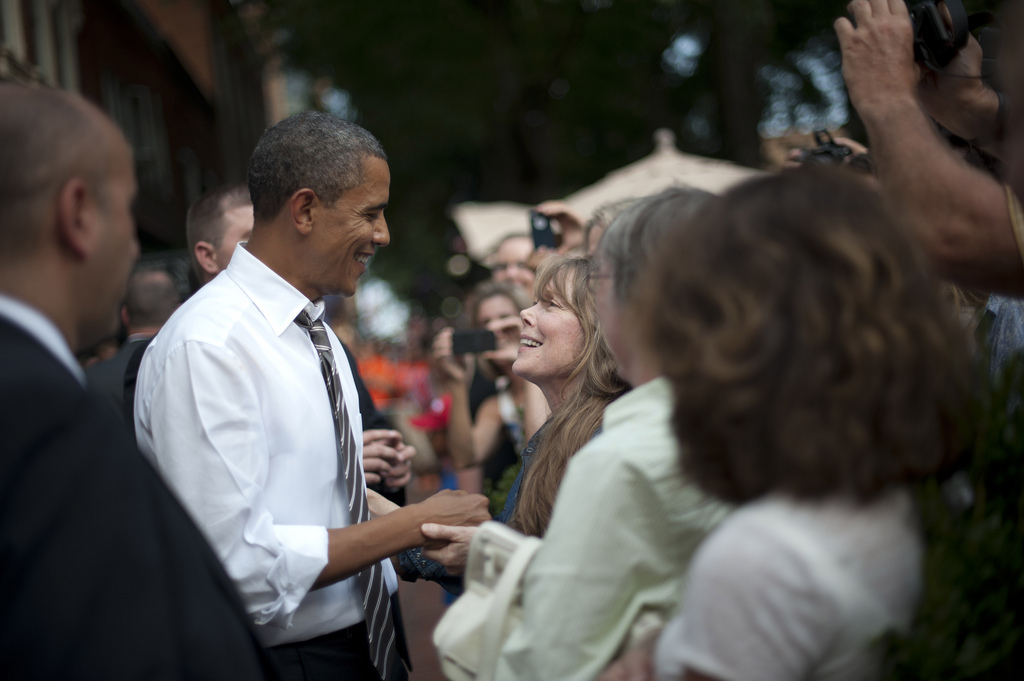

There’s been a lot of talk about politics during the last two weeks. How refreshing. How gratifying to see issue that really matter discussed by people in the streets. Much of the discussion has focused on the events at both national party conventions.
As predicatable as they are, I still enjoy watching. I like an old-fashioned stump speech. It doesn’t matter what is said or which party gets the staring role. These are important spoken by important people. Like them or loath them, their words deserve to be heard by as many people as possible.
Nonetheless, nothing that took place over the past several days — either at the Republican National Convention or the Democratic National Convention — is going to make a dime’s worth of difference when it comes to determining the outcome of the presidential race.
Sure, some speeches were good. Some were bad. A few were great. And a few were awful. But the only people who watch what amounts to political infomericals are political junkies like me (and perhaps you — if you’re reading this article).
Swing voters who will ultimately determine the next President of the United States were indeed watching television during the most recent convention. Trouble was, they were all watching the Dallas Cowboys play the New York Giants. As gifted a speaker as former President Bill Clinton may be, his 48-minute detail-filled primetime speech on Wednesday night fell on deaf ears overwhelmed by the cheers coming out of Giants Stadium.
This is hardly a partisan take on things. According to ratings, Mitt Romney’s acceptance speech at the G.O.P. convention was seen and heard by even less swing voters. If Romney were a television show, he too would be cancelled. So, it doesn’t really matter what President Barack Obama says tonight in Charlotte when he once again accepts the leadership mantel of the Democratic Party. Surely, his speech will be fine, perhaps even electrifying. But it won’t be anything we have not all seen and heard before. It will pretty much be like watching a re-run.
Alas, the electorate appears to be locked into a dead heat and nothing that happened on the two biggest political stages in the country during the last several days changed much.
So, if niether political convention moves the needle for either candidate, what then determines the winner in November? Before answering, first let’s examine other things that will have no impact on the presidential election:
THE PRESIDENTIAL DEBATES — The debates have proven to be turning points in some elections. It won’t happen this time. Both candidates are way too polished, way too experienced, and way too professional to blow it with a gaffe. Look for Barack Obama and Mitt Romney to both come across quite well in a format which suit them perfectly fine. No doubt, Obama possesses communication skills which are irrefutable. And Mitt Romney has become a seasoned debater through 23 Republican Primary debates held earlier this year (in addition to another 20 during his 2008 campaign). Both candidates will perform up to expectations, which means few minds will change. Those that do make a decision based on what they see and hear will probably be splilt down the middle.
ECONOMIC FORECASTS AND JOBS REPORTS — One might think forecasts from top economists would be a tipping point in an election which is largely a referendum on the economy — or more specifically perceptions about the direction of the state of the economy. Trouble is, economists can never agree about anything, and even an overly positive or negative reports aren’t going to do much to budge undecided voters. Those who are swayed by economic issues are likely to cast a vote — not based on what an “expert” or a report says about the economy — but rather by their own personal level of confidence.
TELEVISION COMMERICALS — Given the obscene amount of money that’s aleady been spent during this presidential campaign, the quality if television ads is abysmal. One expects much better — both in terms of content and persuasiveness. In previous presidential races, one or two perfectly-timed ads could sway the outcome of the election (“It’s Morning Again in America” — Reagan 1984 and the infamous “Willie Horton Ad” — Bush 1988 immediately comes to mind). Then, there were the disgraceful “Swiftboat Ads” which distorted John Kerry’s war record which ran non-stop in 2004, which turned the tide for George W. Bush. In 2012, given what’s already known about the two major candidates, most of the “dirty laundry” has been aired. There’s no “October surprise” option for the political spinmeisters. This will make it difficult, if not impossible, to move undecided voters much based on ad campaigns.
NATIONAL POLLS — No matter when they are taken, national poll results are deceiving. In a close race, it doesn’t really matter which candidate is ahead in a national poll since the presidential election is not determined by popular vote. Furthermore, poll results tend to skew slightly in Democrats favor since the biggest electoral prize of all — California — is a blue state. Hence, if Obama wins California by 1 vote or 2 million votes, it’s all the same. In a sense, Obama’s lead in the more populous states contain a lot of “wasted” votes — since the spillover does nothing to add the most important thing, which is electoral votes. National polls and so-called “approval ratings” are pretty much inconsequential. By contrast, poll numbers in swing states do very much matter.


So, if the election was to be held today, who would win?
Let’s do the math.
Based on virtually all projections, Mitt Romney has a solid base of 191 electoral votes. Barack Obama has a base of 221 electoral votes. there are ten “swing states” up for grabs (my tally of swing states is closer to 7, but I’ll concede this point).
Keep in mind, it takes 270 electoral votes to win. So assuming you agree with the base numbers, Mitt Romney has a slightly longer path ahead to cross the finish line.
Here’s my anaysis of how I think those states will go and why:
COLORADO — Republicans have carried Colorado three of the last four elections. But Obama won the Rocky Mountain State by a whopping nine points in 2008, and it’s going to be difficult for the challenger to close that gap. Current polls have Obama leading by about 3 points. There are 9 electoral votes at stake. Based on current numbers, it appears Colorado should end up as a blue state. PROJECTION: OBAMA (+9 electoral votes)
FLORIDA — The Sunshine State is a giant migraine headache to anyone trying to predict an election. Obama carried Florida by 3 points in 2008. Bush won Florida by 5 points in 2004. And, there was the infamous 2000 controversy when Bush and Gore were seperated by less than 100 votes in the closest presidential election in history. This time around, most pundits believe Florida’s sizable Hispanic vote will be the tipping point for the 29 electoral votes at stake. Florida has one of the largest contingents of Latino Republicans, comprised largely of Cuban-Americans. The breakdown is 60-40 leaning Democratic, which is actually good news for Romney because those percentages reveal a siphoning off from what’s considered to be a Democratic base. Current poll numbers show Obama ahead by a fraction (less than one percent). Given the older population base, southern influence in the northern part of the state, some disefranchisement on the part of Jews who are critical to an Obama victory, a mortgage/foreclosure crisis which hit this state hard, an energized Latino Republican base, and Republican Senator Marco Rubio’s popularity, I see this as a Romney state. PROJECTION: ROMNEY (+29 electoral votes)
IOWA — Recall that Iowa gave President Obama his first victory on the presidential level back in 2008, when he upset the party establishment in the Iowa Caucuses. No doubt, this is Obama’s state to lose. He won Iowa by a whopping ten points in 2008. The last Democratic incumbent president (Bill Clinton) also won Iowa by ten points in 1996, and that was running against a popular fellow Midwesterner (Bob Dole). Both of the George W. Bush elections were razor close, within a single percentage point. Iowa tends to skew a little more liberal than other states in the midwest. While poll numbers show a dead heat at the moment, I view this as a relatively safe state for Obama. PROJECTION: OBAMA (+6 electoral votes)
MICHIGAN — Despite Romney being born and spending a lot of his childhood in Michigan where is father was Governor, the Republican will have a tough time winning this state. Look for a barrage of ads from Obama reminding Michigan voters of Romney’s opposition to the auto bailout, which will not play well in a state with many jobs still tied to the auto industry. Current poll numbers show Obama ahead by about 2 percentage points. This state has gone Democratic five straight elections. Obama destroyed McCain by 16 points here back in 2008. I see no way Republicans can win here. PROJECTION: OBAMA (+16 electoral votes)
NEVADA — This is a tricky state. One would think Obama should carry The Silver State once again. But the mortgage crisis has hit Nevada harder than anywhere else. A recent survey found that as many as 60 percent of Nevadans have mortgages that are upside down. I think that’s going to hurt Obama in this state. There’s talk that the large population of Mormons in Nevada will help Romney. But I don’t see this as a factor since most Mormons vote Republican anyway. Oddly enough, Romney’s anti-gambling stand and the Republican Party platform with an expressed opposition to online gambling doesn’t seem to hurt their numbers in a state where gambling is the biggest source of jobs. This should be a close race and Democrats have done an excellent job registering new voters (about 3 to 1 according to a news report today). But Romney wins here based on such a poor economy. PROJECTION: ROMNEY (+6 electoral votes)
NEW HAMPSHIRE — This is viewed as a swing state. I disagree. Democrats have won here four out of fives times, and the only Republican victory was Bush winning the state by s single percentage point in 2000. Obama won here by 9 points in 2008. Economic troubles do not seem to have hit New England quite as much as the rest of the country, and it’s difficult to see how Romney, even though he’s the former Governor of a neighboring state, is going to reverse enough minds to win the small prize. PROJECTION: OBAMA (+3 electoral votes)
NORTH CAROLINA — Here’s another state where I take strong exeption to pundits. Obama will have a very tough time winning what remains as a very conservative state, particularly on social issues. Despite a national landslide, Obama won this state by just one percentage point four years ago. Republicans won here easily the previous three elections. Current polls show Romney ahead by 5 points. If I was running the Obama campaign I would not spend a dollar here or an hour here. It’s a waste of time. North Carolina is a red state and nothing foreseeable is going to change that. PROJECTION: ROMNEY (+15 electoral votes)
OHIO — This is the most important state in the 2012 presidential election. Although it’s hard to foresee Romney winning the presidency without carrying Ohio (do the math on the other swing states and you’ll see why), it’s possible for Obama to lose both Ohio and Florida and still cross the 270-mark, provided he sweeps the other states projected here by me (in this article). Quite simply — Romney must win here, or it’s over. Obama won Ohio by 5 points in 2008. But Republicans carried the state rather comfortably in both 2000 and 2004. A major concern for Democrats has to be possible voter supression. Look for controversies again regarding poll stations (longer lines in Democratic-leaning areas) and charges of irregularities. This is a state where things could get very ugly because Republicans know it’s a “must-win.” Current polls show this as a dead heat. PROJECTION: TOO CLOSE TO CALL (+/- 18 electoral votes)
VIRGINIA — Obama will win Virginia. The last three presidential elections have seen Democrats win by increasingly larger percentages each time. This is because Virginia is changing. Democratic candidates won just 44 percent of the vote in 2000, 46 percent in 2004, and 53 percent in 2008. That’s a steady nine point move in 12 years. Add some demograpic changes which also help the incumbent Obama in Virginia. This is a state increasingly connected to the federal government (hundreds of thousands of civil servants and contractors) which vote overwhelmingly Democratic. Northern Virginia’s growth has mushroomed in recent years due to the expansion of several agencies. This also makes the state lean more Democratic. Although this is also a very pro-military state (with several notable bases and retirees), many give the President high marks for his handling of foreign policy. There’s virtually no dissent among the military when it comes to the current commander in chief. Virginia has a higher percentage of Blacks than the national average (20 perecent statewide versus 13 percent nationally) — which boosts Obama’s numbers significantly. Fact is, the Commonwealth of Virginia is becoming more like a northeastern state than a southern one. Obama should win here. Easily. PROJECTION: OBAMA (+13 electoral votes)
WISCONSIN — In addition to Ohio, Romney probably needs to win Wisconsin to get elected. It’s going to be tough. Obama won this state by 14 points four years ago. Other than a neck-a-neck race in 2000, Wisconsin has gone Democratic in every recent election. But Romney holds two potentially decisive wild cards which could close the gap — Vice Presidential candidate Paul Ryan (from Wisconsin) and a victory by conservatives in the recent recall election of Governor Scott Walker, who stood up to unions and then managed to weather a storm of criticism. Romney has to play this state very carefully because any perceived attack on workers will devastate him in states with similar demographics — such as Michigan and Ohio. Obama is ahead by 2 points at the moment. He’s the clear favorite t win what should be a close race. But Romney has a fighing chance. PROJECTION: OBAMA (+10 electoral votes)
OVERALL SCOREBOARD (270 electoral votes needed to win):
OBAMA — 279
ROMNEY — 241
TOO CLOSE TO CALL — 18