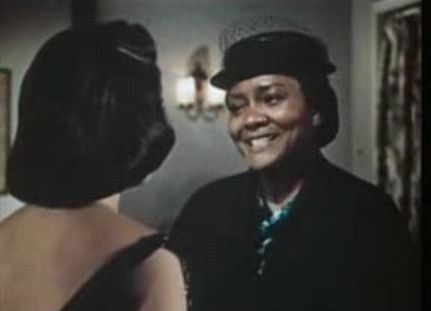

Juanita Moore died a few days ago.
If you don’t know that name, you’re not alone. I didn’t know her either.
But I do remember her most memorable film role, in what was (and remains) one of the most groundbreaking movies ever made. The name of that film is Imitation of Life.

This movie has special meaning to me because it was one of my mother’s favorite films. We watched it together when I was young, and it made quite an impression. This isn’t to say it’s a movie for children. It’s not. In fact, it’s a very sad and troubling movie, which was way ahead of its time.
Made in 1959, Imitation of Life tells the story of two single mothers. One is White, and the other is Black. Both have daughters about the same age. They play together.
People aren’t born to be bigots. Among young children, race and color aren’t important. It’s only later as we grow up and develop our prejudices that people — and people’s perception of each other — changes. There’s something inherently troubling in that fact.
In the movie, Juanita Moore plays the role of the Black mother. Fittingly, she was nominated for an Oscar for her performance.
Aside from the controversial subject matter (about race), Imitation of Life was highly unusual for its day. For one thing, it appealed mostly to women and minorities. It’s also cited in the gay community as a landmark cinematic inspiration. No doubt, gays (or anyone who feels the need to hide their true identity) can sympathize with concealment and the persecution of people who are different.
The Black woman’s daughter happens to be very light-skinned. Hence, she can pass as “White” in daily life. Facing the overt racism of the day, the daughter makes a decision that deeply hurts her mother. She decides to be White. As the girl matures into adulthood, she sees the doors opening to Whites that are closed to Blacks. For this reason, she goes to great lengths to hide her true ethnicity. She decides to live entirely as a White person. She begins dating. At one point in the movie, a boyfriend comes to the apartment and sees the mother, who is introduced as “the maid.”
The movie is somewhat dated now, so I’ll assume the ending can be freely discussed.
The mother dies, convinced for the remainder of her life that her daughter was ashamed. Only after learning of her mother’s death, does the daughter finally come to realize that her abandonment caused such heartache. The movie ends with the daughter crying as her beloved mother’s coffin is carried away at a funeral procession.
It’s a brutally penetrating film that must have been shocking to audiences in an era just before civil rights.
In real life, Juanita Moore was nothing like the mother she played in the film. Her obituary said she lived 99 happy years. She was married for more than half a century to the same man, who was a bus driver. She is survived by a grandson — and one very special old movie that should be remembered as a bold and brave testament to being who we really are.