
EVERY PICTURE TELLS A STORY:
THREE RIVERS STADIUM — PITTSBURGH (1990s)
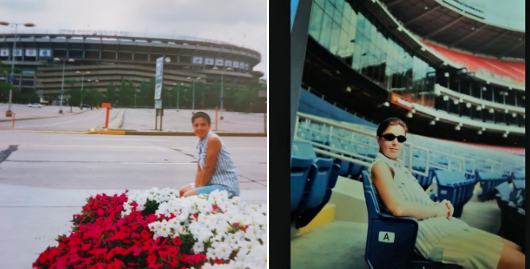
Continuing with the ghosts of stadiums past, here’s Marieta both outside and inside Three Rivers Stadium in Pittsburgh. I’m not sure what year it was taken — probably in the late 1990s.
I consider Pittsburgh the most livable city in America (at least among all the large cities I’ve visited). It’s big enough to have just about everything, but its many neighborhoods each seem like a small town. Pittsburgh has many excellent restaurants, friendly people, and is remarkably scenic. It’s also somewhat affordable contrasted with most big cities, especially when compared to metro areas in the northeast. Perhaps most impressive, Pittsburgh completely transformed itself and revamped its image from a gritty city choking on steel mills into what today is a epicenter of high-tech, education, and medicine.
I’ve been to Pittsburgh maybe a dozen times. Marieta and I used to drive there from Washington, spend the weekend, then return home (a 4-hour drive). It was an interesting destination. We never ran out of things to do and see, or festivals to attend, especially in the surrounding area. Pittsburgh is also a great sports town with a long history of winning teams. The Pirates, Steelers, and Penguins have all enjoyed moments of greatness.
Three Rivers Stadium was one of those much-maligned “cookie-cutter” multi-purpose sports stadiums constructed in the 1960s and 1970s (a.k.a. “concrete doughnuts”). Architecturally speaking, they all looked identical — perfectly round, multiple decks, ugly artificial turf, utterly drab and antiseptic. Home games in Pittsburgh, Cincinnati, St. Louis, Atlanta, and Philadelphia all looked pretty much alike on television. They were used for both baseball and football. Because of the different field shapes, spectators at football games were often far away from the field. Most of them were decent for watching baseball, but terrible for football.
Three Rivers Stadium’s construction and opening could not have been timed more perfectly. Shortly after moving into the new ballpark, the Pittsburgh Pirates won the 1971 World Series. The following year, the Pittsburgh Steelers made the NFL playoffs for the first time in 25 years, thus igniting a dynasty and four Super Bowl victories in the ’70s. When the Steelers and Pirates won duel championships in 1979, Pittsburgh became known as “the city of champions.”
During one of our visits, we snuck into Three Rivers Stadium. We even walked across the field and touched the sacred spot where the “Immaculate Reception” occurred in the 1972 AFC Divisional playoff game. Like most fans who grew up watching games played in Pittsburgh, I have lots of memories from this place — though they were all via television. Since I grew up in Dallas in the ’70s, Pittsburgh was enemy territory. Sitting in the stands on this occasion, then walking onto the field really added to my perspective and brought back chills. Oh, and I never could figure out what was behind that huge pane of black glass that was so omnipresent during all the games — as though Oz was looking through a one-way mirror in a police interrogation room. See the photo with Marieta in front of that massive black glass facade. Ah yes, the huge black mirror — what was behind it? Does anyone know?
Oh, and one other quirky feature of the old Three Rivers Stadium — the cars in the end zones. It seems every home game had an ugly shitbox of a 1974 Buick parked near the end zone line. What was that all about? Anyone else remember those cars?
On a frigid 21-degree February morning in 2001, Three Rivers Stadium was demolished. Today’s it’s a parking lot for Heinz Field, home of the Steelers.

