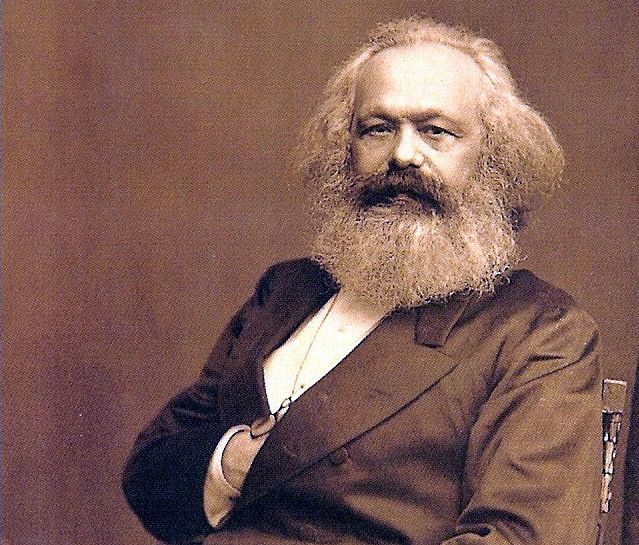

Karl Marx wasn’t a political fanatic, nor was he an extremist. Certainly not when you examine his writings. In fact, back in his day, Marx is what we’d now call a social commentator. He wrote about politics, economics, and world events. Since television “talking heads” didn’t exist back then, Marx instead scribed his ideas. Those views were published in newspapers and periodicals, including even some based in the United States. He also wrote a few notable books, which weren’t particularly well-received when they were initially written, another way of saying Marx was way ahead of his time.
de obmibus debutandum
(Translated from Latin, means to “doubt everything.”)
If Karl Marx were alive today, he’d be making frequent guest appearances on CNN, MSNBC, and perhaps even FOX News. That’s right. Imagine Marx sitting opposite Bill O’Reilly.
Marx wasn’t a political fanatic, nor was he an extremist. Certainly not when you examine most of his writings. In fact, back in his day, Marx is what we’d now call a social commentator. Think of a leftist version of George Will. He wrote about politics, economics, and world events.
Since television “talking heads” didn’t exist back then, Marx instead scribed his ideas. Those views were published in various newspapers and periodicals, including even some based in the United States. He also wrote a few notable books, which weren’t particularly well-received when they were initially written, another way of saying Marx was way ahead of his time.
Marx doesn’t merit our reverence. He’s certainly no ideological messiah. But he doesn’t deserve universal scorn nor condemnation either. Based on several passages of his writings and his character revealed later by those who knew him best, it’s accurate to say Marx would have been utterly mortified to see the terrors perpetrated in his name, carried out a century later in places like the USSR, Red China, East Germany, North Korea, and other bastard regimes.
Fact is, Marx only commented on the events of the 19th Century. He couldn’t have foreseen the bloody horrors to come. Like Jesus or Mohammed. The comparison fits. Pol Pot would have been inconceivable to a struggling academic from Trier in the 1830s. Moreover, let’s bestow credit where it’s due. Marx got lots of things right. He also got some things wrong, which just goes with the territory when commentating on unstable political and economic systems with lots of moving parts. He never proposed forming a political movement, although several grotesque variants materialized which dragged his name and historical reputation through the mud. To this end, Marx became a victim of history. I would go so far as to say he was a tragic figure.
Leninism, Stalinism, Maoism would become the nuclear holocausts of political thought. Like Marx’s writings, the idea of fission may have initially been sound. What was actually done with the science becomes a matter of contention. As I said, some terrible things happened because of the Old Testament and the Koran, too.
But that’s not the way popular attitudes gel. Ideology isn’t organic. Rather, it’s politically pasteurized by the events of the day. Whether it’s Ebola or ISIS right now, or whatever worries us tomorrow, we seek simple answers to complex questions. That’s not how it works.
Indeed, real understanding takes time and effort. Overcoming historical misrepresentation takes courage. It all takes an open mind, in a world that largely consists of nonsense barreling down the lunatic fringe assembly line.
Marx and his ideas deserve to be reported and understood accurately, instead of the amalgamation of emotions and lightning rod for the evil that he’s become.
Given how loosely Marx’s name gets tossed around — even today (how often do we hear claims that “Obama is a Marxist?”) — now is the perfect time to look more closely at this fascinating man who lived from 1812 to 1883.
As you read further, I’ll later pose a question: Is being a Marxist — that is, believing in the words and ideas expressed by this social commentator — really so extreme?
Consider the following 25 things about Karl Marx you might not know:
(1) Marx wasn’t Russian. He never visited any of the countries which would (allegedly) later come to practice his philosophy. Marx was born in what is now Germany. He lived in one of the more enlightened societies in the world, filled with cultural and artistic expression.
(2) Marx’s parents were Jewish. However, they later converted to Christianity (Protestantism). This was reportedly to avoid fears of rampant antisemitism. Young Karl Marx was baptized in the Lutheran Church. Tell that to your Sunday School class.
(3) From early adulthood Marx openly claimed to be an atheist. Oddly enough, that self-proclamation — highly unusual for its time — made him even more of a social outcast than if he were Jewish. His rejection of religion certainly hurt him professionally and economically much of his life.
(4) Marx and his wife had six children. By all accounts, he was a devoted father. Marx created funny nicknames for each of them.
(5) Marx was burdened by health problems during most of his life. He had severe liver problems, suffered from rheumatoid arthritis, endured migraine headaches, and complained constantly of toothaches.
(6) Marx was an insomniac. He often slept no more than three hours a night.
(7) Marx loved the arts. He initially wanted to become a theater and drama critic. But his father talked him out of this career pursuit insisting there was no way to make a decent living attending opera and plays and writing about the theater.
(8) Marx was immensely popular while studying in college. He often paid for parties and nights out on the town with friends. He dated often. His out-of-control spending habits left him and his parents in serious debt.
(9) Marx attended universities in Bonn, Berlin, and Jena. He earned a Ph.D. and was a Doctor of Philosophy.
(10) Marx lived in poverty for most of his life. While they collaborated, his close friend Friedrich Engels provided him money on which to live every month.
(11) Marx met his lifetime writing partner Engels at a street cafe while living in Paris in 1843. After a two-year residency, they both moved to Brussels where they remained for another two years. After that, they moved to Cologne along with their families. Remarkably, the duo long associated with communism spent most of their lives in Germany, France, Belgium, and England — countries that would become the bulwark against the movement during most of the next century.
(12) Marx’s historical hero was Spartacus, the Roman slave, and leader of a popular uprising and revolt.
(13) Marx’s personal motto was “nothing human is alien to me.”
(14) One of Marx’s early political writings was an expose on the gross mistreatment and exploitation of vineyard workers along the Rhine River. The controversial story caused quite a stir and led to unskilled workers’ rights being debated seriously for the first time.
(15) Marx did not invent communism, which essentially means private property rights are dissolved in favor of common (shared) ownership. Such ideas were first proposed by French philosophers, including Jean Jacques Rousseau, in 1762. Those ideas would spark the French Revolution a generation later.
(16) Because of his intense pain and multiple ailments, Marx often took doses of arsenic and opium, which in those days were thought to cure some health problems. He found it so painful to sit down that he often wrote while standing.
(17) Marx spent most of his life working as a journalist. His writings were revolutionary at the time. Some of his ideas included abolishing child labor, providing free public education to all citizens and making school attendance mandatory, and implementing a gradual income tax based on personal income. Virtually all western societies would adopt these “revolutionary” ideas within the next 70 years.
(18) One of his most famous books, The Communist Manifesto, was completed in only six weeks. Das Capital, the first edition of his masterwork was also written in a short amount of time.
(19) A year after The Communist Manifesto was published in 1848, Marx was expelled from Prussia (modern-day Germany) and stripped of his citizenship.
(20) At the time he was expelled from the country, Marx was the editor of a progressive newspaper that featured stories on economic inequity and unfairness. When he learned that the paper would be shut down by authorities, the final issue of the paper was printed in red ink. That later became the basis of red being associated with communism.
(21) Marx found a job as a reporter in England and moved to London.
(22) While in London, Marx wrote for an American newspaper called The New York Daily Tribune. He served as one of the paper’s European correspondents. Marx initially wrote in his native German language which was translated into English once it reached New York. However, Marx learned English well enough to eventually write all of his columns in the English language. He was fluent in at least four languages.
(23) Among the many topics covered by Marx was the issue of slavery in America. He wrote passionately about its terrible inhumanity. When The New York Daily Tribune changed management prior to the American Civil War, it also changed its editorial position on this issue and was no longer an abolitionist paper. Despite needing the job at the time, he parted ways with his employer.
(24) Marx’s ideas were intended to be applied to the most modern industrialized societies, such as England, Germany, and France. Instead, they were adopted in Russia (and later China) which were overwhelmingly agrarian societies and lacked the proper political and economic infrastructure to achieve success.
(25). Late in his life, Marx attended a political rally that had formed and taken his name. When he found out what they believed and wanted to accomplish, he famously proclaimed, “If they are Marxists, then I’m not a Marxist.”
A couple more…
(26) Marx loved poetry and often wrote about romance. He penned dozens of poems, later judged to be quite respectable. These poems were discovered after his death and were published in 1929.
(27) Marx is buried in London, at Highgate Cemetery.
So, do these revelations change anything? They should.
In this poisonous political climate of such historical ignorance, let fact be separated from fiction. Next time someone is labeled as a “Marxist,” it would be wise to remember who Karl Marx truly was and reflect upon those beliefs. Sorry, right-wingers, President Obama is no Marxist. No one is or was — except Marx.
Demagogues who intend on continuing to use “Marxist” as a slur reveal a lot more about their own ignorance than the target of derision. In fact, based on the points above, the tag might rightfully be construed as a compliment.