

“I don’t give a fuck about rock and roll,” Sting emphatically declared in 1987. There was, he complained, “no new fuel in rock music.” Instead, Sting insisted, writers and musicians should be looking outside of rock and into African, jazz, raggae, funk, and even classical music: “Anything! Anything will do.”
The musical alchemy of Sting’s angst of frustration with being an international rock star was Nothing Like the Sun, a double album released in 1987.
This was a bold personal and artistic statement from a monstrously-successful former-rock bandsman and self-assured songwriter who at the time was eager to put The Police years behind him. He was determined to prove the critical and commercial success of The Dream of the Blue Turtles, his first solo album, was no fluke (Note: Sting also released a jazz-laced live album in between titled Bring on the Night, which is excellent).
It wasn’t a fluke.
Nothing LIke the Sun was another leap forward, yet darted off in so many unexpected musical directions that it remains impossible to predict or classify as a genre. And so it succeeds in doing what all essentially great albums do which is to shine entirely as a whole and as one.
Typical of the mood and sound that came to define much of Sting’s lengthy and immensely fruitful career as a solo artist, much of the music contained here is sullen and introspective. Yet, it’s often politically charged and filled with cheery optimism. That’s hardly a surprise since the album was recorded just a short time after the death of his mother in late 1986, and in the shadows of his role as one of the frontmen in Amnesty International’s global concert tour, which sent Sting to the aftermath of a shredded Latin America that had been ravaged by civil wars, brutal military dictatorships, and put the superstar singer into direct confrontation with many victims of decades of government oppression. One could say the memorable concerts during the mid-80s in places like Santiago (Chile) and Buenos Aires (Argentina)–which were unaccustomed to major rock acts touring at the time–made Sting into a changed man. Or at least, a more focused songwriter.
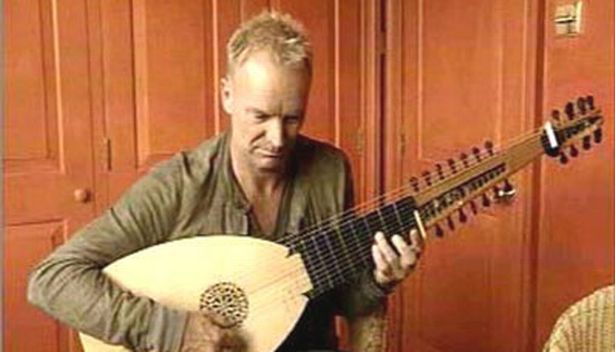
The racier days of pop-hit temptation embellished in “Roxanne” or “Don’t Stand So Close to Me” or “De Do Do Do, De Da Da Da” gets obliterated here by new sounds, more interesting instrumentation, and a far more purposeful set of lyrics. Call it the start of Sting’s “lute period.”

For instance, Sting likely wouldn’t have been inspired to compose “They Dance Alone,” a gorgeous yet haunting 7-minute tribute to hundreds of Chilean mothers who danced the Cueca, the national dance of Chile, while holding photographs of their disappeared and dead loved ones in their hands. The song which honored mothers and their children who were murdered by the regime of dictator Augusto Pinochet was later performed on numerous occasions, but none quite as emotional as the night of the AI return tour, which was performed in front of 100,000 at River Plate Stadium in Buenos Aires in 1988 (along with Peter Gabriel). Note, the song was also performed two years later in Santiago, with the mothers onstage:

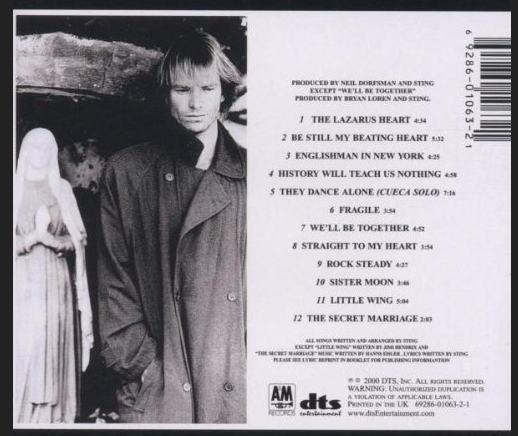
Recorded on Montserrat, in the Caribbean, the album also contains one of the catchiest dance tracks of the decade, “We’ll Be Together,” a riveting, funk-inspired, synthesizer-driven song with quite a surprising backstory. Commissioned by the Kirin Beer Company in Japan to write a jingle for a new television commercial, Sting wrote the song in only a few minutes and then quickly tagged on the lyrics after they asked him to use the word “together” in the medley. “We’ll Be Together” turned out so well that Sting decided to include it in his forthcoming recording sessions for Nothing Like the Sun, which later became its first single, rising to #7 on the Billboard charts.
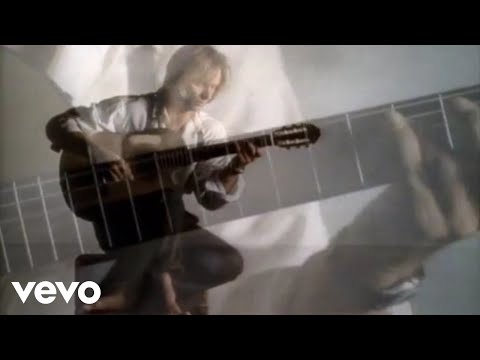
Other hit songs from the album that charted included “Be Still My Beating Heart,” and “Englishman in New York.” However, no track from the 12-song collection was quite as wondrous and everlasting as “Fragile,” a guitar ballad tinged in the Flamenco style layered with Sting’s breathy vocals. The song still gets airplay and has been used repeatedly in several movies. Though the lyrics remind us of “how fragile we all are,” the song was originally intended as a tribute to Ben Linder, an American civil engineer who was killed by the U.S.-backed Contras in Nicaragua. Sting later performed “Fragile” in Spanish and Portuguese languages numerous times. It’s been covered by many other artists since then, including Julio Iglesias. Here’s the official video release, with Sting:
Though Nothing Like the Sun is ostensibly a solo album, the energy and diversity are greatly enhanced by Sting’s familiar studio and on-stage collaborators — including Branford Marsalis, Mark Knopfler, Eric Clapton, Rubén Blades, and former Police bandmate Andy Summers. Eleven of the 12 songs are original compositions. Only “Little Wing,” the revered Jimi Hendrix cover (originally released in 1967) is from outside of the Sting songbook.
“I had this kind of monkish life,” Sting later told Rolling Stone about this creative period of composition. “I lived on my own (in New York). I cooked my own food. I went to the gym every day. I took piano lessons. The phone was off the hook. And I worked usually from twelve midday to very late at night.”
Sting’s record company (A&M Records) initially questioned the wisdom of his broad musical expeditions on Nothing Like the Sun. In fact, some thought it was way too ambitious, especially for the mid-80s, not known as a period when the record-buying public was hungry for deep personal introspection or songs about people killed by military dictatorships.
“It wasn’t simple enough or directed toward the charts,” Sting recalled. “I said, ‘Why underestimate the record-buying public?'”
He was right. The album sold 2 million copies in the U.S. alone, and rose as high as #9 on the American charts, in addition to five successful singles which aired frequently on the radio (oddly enough, it didn’t perform nearly so well in the U.K.). Nothing Like the Sun also garnered three Grammy nominations, including Album of the Year (Faith, by George Michael, won top honors that year).
Indeed, Sting’s second solo album doesn’t dumb anything down. It respects the listener. It invites us on his journey. It takes us to different places. It introduces us to sounds and beats not typically attached to pop music.
This all makes Nothing Like the Sun an essential album to have and listen to.

Note: This is the latest segment in a series of reviews and retrospectives of my “100 Essential Albums,” which will be posted here regularly on my website. Check out my previous selections and retrospectives on each album here:
#100: Black Moses — by Isaac Hayes (1971)
#99: Soul of a Man — by Al Kooper (1995)
#98: Jagged Little Pill — by Alanis Morissette (1995)
#97: Ol’ Blue Eyes is Back — by Frank Sinatra (1973)
#96: The Doors — by The Doors (1967)
#95: Ellington at Newport — by Duke Ellington (1956)
#94: Back to Black — by Amy Winehouse (2006)
#93: Teatro — by Willie Nelson (1998)
#92: Sail Away — by Randy Newman (1972)
#91: Fiddler on the Roof — by Original Broadway Cast (1964)